

Comparing Legacy and Headless CMS Costs

INTRODUCTION
A Content Management System (CMS) is a major investment. In addition to the countless ways it can impact your content strategy, it can also impact your bottom line for years to come. And like with any other investment, making the right choice is dependent on having the right information.
According to the State of CMS 2024, 41% of legacy users said that they weren’t using a headless CMS because the cost was too high. Headless’s power is well known, but it seems to have gained a reputation for eyewatering prices.
But is that even true? Are headless systems really more expensive than legacy ones?
We surveyed 43 companies with 5000+ employees to see what they paid for implementation, yearly maintenance, and training and support for their CMSs. The results speak for themselves: headless CMS pricing was cheaper across all categories compared to legacy systems. We’ll break down the data and explore why headless offers such economic advantages.
Let’s set the record straight.
Executive Summary
Our sample comprised of:
- 43 companies with 5,000+ employees each
- 20 legacy systems, 23 headless
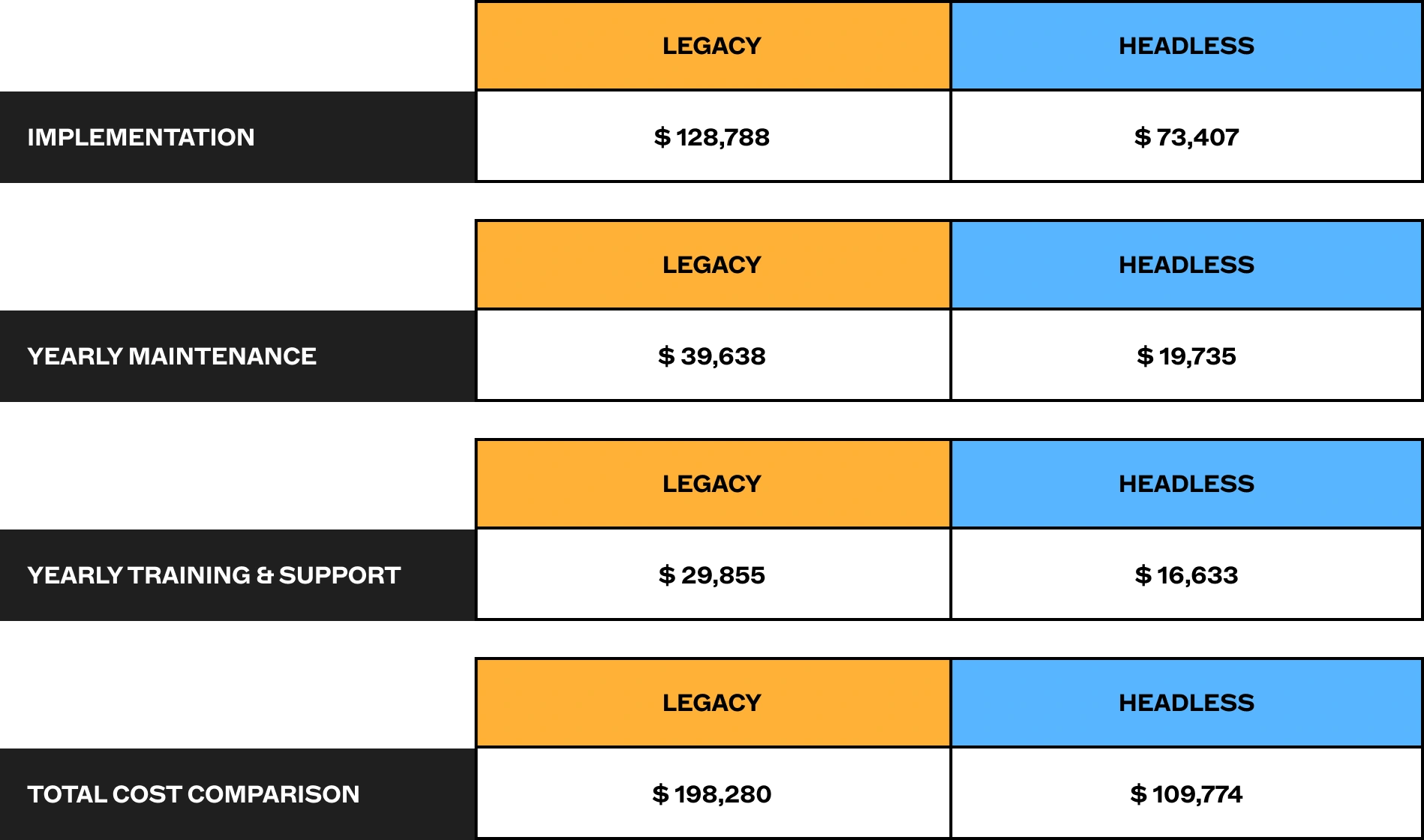
Across 43 companies with 5,000+ employees, those using headless systems spent an average of nearly $88,500 less than businesses with legacy systems on the total cost of CMS ownership.
This included all three major spending areas:
- Implementation: Licensing fees, initial customization and integration, and infrastructure setup
- Yearly Maintenance: Scaling, software updates, and custom expansion plans
- Yearly Training & Support: Onboarding and staff training, technical support, and ongoing education
PART 1:
Implementation

In this study, headless CMSs consistently achieved a lower cost of implementation than legacy systems. Those who embraced headless saved an average of $55,000 on implementation. Now that’s what we call getting started on the right foot!
Factors Influencing Implementation Costs
LICENSING FEES
Legacy systems often advertise themselves as having every feature you could need. The part they don’t tell you is that you get them – and pay for them – whether you want them or not. Basic CMS functionality is often bundled with extras that do little more than take up space in your system. They’re also nearly always inseparable, so you can’t even save cash by opting out of features you’re not using. Perpetual licensing and on-premise hosting costs only rub salt in the wound.
Headless CMSs are designed to sidestep the entire circus completely by enabling best-of-breed selection. You can build your tech stack exactly how you want to. No paying for features you don’t need, and no costly workarounds to achieve functionality your CMS doesn’t already come bundled with. Just total control of your tech and your budget.

CUSTOMIZATION & INTEGRATION
Legacy systems are customizable – assuming you have tons of time, plenty of resources, and a boatload of patience. Even minor changes require you to hack through a dense forest of complex, integrated codebases. You can thank the inflexible setup for that. This can increase development time and implementation costs. Even if you’re willing to overinvest like that, proprietary legacy systems can still place strict limits on how your customizations can be implemented. That means you’re still struggling with a workaround, and you’re still overpaying for it.
A headless CMS’s decoupled front and backends eliminate those legacy struggles. This flexibility doesn’t just give you the freedom of choice; it can save you cold hard cash, too. One way is through Packaged Business Capabilities (PBCs). These prebuilt components can give you the benefits of bundling without the limitations. And if you prefer a fully best-of-breed approach, you can fully embrace it without the costs of circumventing rigid architecture. No matter which approach suits you best, you’re free to customize your CMS more efficiently and at a lower cost.
INFRASTRUCTURE SETUP
Most legacy systems require you to engage with on-premise or managed hosting infrastructure to host the entire platform. This can rack up charges for hardware costs, cloud provisioning, server configurations, and more. Oh, and they’ll need to be robust enough to support the whole platform, which can balloon your infrastructure setup costs.
But headless CMSs tend to sidestep that entirely. Since they’re usually run as SaaSnative solutions in the cloud, you’re looking at fewer infrastructure costs. Front-end experiences can also be deployed on modern PaaS (Platform as a Service) solutions such as Netlify and Vercel. The result? Increased efficiency, decreased operational costs, and a more affordable scaling process.

LOOKING TO LOWER YOUR IMPLEMENTATION COSTS?
Working with an AWS Marketplace Channel Partner can help you save both time and money:
- Receive customized pricing, contract terms, and payment schedules for third-party software purchases with Channel Partner Private Offers (CPPO). CPPO purchases can even apply towards your spend commitments!
- Find and buy complete end-to-end solutions by purchasing third-party software and professional services in AWS Marketplace.
- Reduce time and resources spent reviewing contracts with Standardized Contracts for AWS Marketplace.
Learn more about how you can save with AWS and Storyblok.
PART 2:
Yearly Maintenance Cost

Our research shows that composable systems are more cost-efficient for enterprise organizations by an average of nearly $20,000.
Factors Influencing Yearly Maintenance Costs
SCALLING
Legacy systems were never designed to scale in the modern world. Because all components are tightly integrated and share the same infrastructure resources, scaling one part of the system usually requires scaling the entire platform – even parts that don’t need to grow. You end up overpaying any time you try to expand, dealing with inefficient resource utilization and higher costs. As your organization scales, so do these unnecessary charges.
But headless systems aren’t all-ornothing. Since each component exists independently, they can be scaled independently too. That means you’re in full control of your growth strategy, and only need to pay for what you need. As a bonus, these components are often hosted on cloud services, so you also get the benefits of being able to adjust resource location in real time for efficient spending.

SOFTWARE UPDATES
Similar to those found in implementation costs, using a legacy CMS means dealing with all-important periodic software updates. Doesn’t matter if you need any of the new features or not – bug fixes are often bundled with new features, so you’ll need to opt in for security’s sake. If you’re staring down the barrel of a larger software update, you might want to brace for an equally large price jump to follow.
On the other hand, headless CMSs are usually SaaS solutions and come with automatic updates. This means the SaaS vendor is responsible for rolling out those updates, so you can sit back and relax. While there is the possibility of PBCs or integrated programs having software update costs to contend with, you’ll never be locked into them. Swap them out with your favorite alternative and you’re good to go.
CUSTOM EXPANSION
Just like we saw in the implementation stage, customizing a legacy CMS is challenging and expensive. As new needs emerge, adapting to them is more costly and time-consuming – if rigid templates and bloated code let you customize in the first place. Not only will you pay dearly for any bespoke features, but you may also see a dip in revenue if it extends your time to market.
The opposite is true for headless systems. Quicker, easier adaption of new technologies means less time and money spent on growth. Headless’s unrivaled agility also means you could be looking at a faster time to market, better capitalization on business opportunities, and a Return on investment (ROI) that makes everyone happy.
PART 3:
Yearly Training & Support Cost

On average, headless costs for yearly training and support were lower than monolithic costs. This was a difference of over $13,200.
Factors Influencing Yearly Training & Support Costs
ONBOARDING & STAFF TRAINING
Legacy systems being all-in-one might seem like they’d be simple to operate. However, the opposite is often true: because everything operates in one unit, your users will need to understand every part of the system just to interact with it. This can lead to pricey additional training courses and lost working hours just to get a baseline of familiarity going.
But with headless, you can take a far more targeted approach. You only need to train for the components that you’ll interact with. If you’re a content editor, for example, you won’t need to learn how to use the database, sales programs, or technical back end just to make simple changes. This allows for efficient use of training budgets – not to mention saving hours of valuable time.

TECHNICAL SUPPORT
Support costs for legacy systems are usually bundled into the contract. This convenience comes with a dark side: options are typically inflexible, so you could end up paying for support that you’ll never even use.
If you have a headless CMS, you can pick and choose support contracts for each component. You can save a lot of cash this way, especially if you have someone in-house who understands the tech and doesn’t need support options.
ONGOING EDUCATION
Ongoing legacy education often looks like your team attending vendor-specific courses and certification programs. As the name implies, they’re often available only from the vendor themselves and can be costly or time-consuming. If you want your team to remain proficient with your content engine, it’s something you’ll just need to live with.
With a headless CMS, you can target ongoing education to specific components or teams only. This can lead to fewer training hours and thus a lower cost. And if you’re not happy with ongoing education prices? You’re in full control. Just swap to a more affordable alternative and you’re good to go.
Legacy CMSs have their perks. Setup can be simple, and the limited features might not be roadblocks for small businesses. But despite what you may have heard, “simple” does not mean cheap. Users contend with ongoing operational costs like licensing fees, infrastructure maintenance, and vendor lock-in – all while struggling with a limited ability to customize their systems.
That’s where headless comes in.
Thanks to an innately modular architecture, you’re in full control of your tech – and as a result, it’s cost. You’re free to integrate best-of-breed services that meet your exact needs, not a generic all-in-one package that doesn’t. Not only does this flexibility unlock the freedom to respond to market changes with agility, but it also skips the overhead associated with maintaining and upgrading a rigid legacy system.
Headless systems still require a financial investment. But our data shows that it is far below what is required by a legacy framework – specifically, $88,500 less on average. If you’re ready to embrace a flexible, future-forward content strategy that’s worth the investment, go headless. Your team – and your wallet – will thank you.
About Storyblok
Storyblok is the headless CMS for marketers and developers who want to make bigger, faster market impact.
Developers thrive with the freedom to build better, faster, more flexible content experiences using their chosen tech stack. Marketers move with agility and independence, effortlessly editing, personalizing, and publishing content across every channel.
And customers? The seamless content experiences keep them engaged, delighted, and coming back for more.