



End Marketer and Developer Codependency


Executive Summary
Let’s talk about the elephant in your digital room: that traditional CMS that’s supposed to be the backbone of your content operations but feels more like a creative straitjacket. It’s the system that turns simple content updates into epic sagas and transforms collaboration between your marketing and development teams into a never-ending game of technical ping-pong.

Here’s the reality check: Your content management system should be a powerful tool in your digital arsenal. Instead, it’s become that awkward middleman that makes everyone’s job harder. Your marketing team crafts brilliant, time-sensitive campaigns only to watch them age like fine wine in development queues (except wine actually improves with age—your campaigns don’t). Meanwhile, your developers, hired to architect sophisticated solutions, f ind themselves playing digital janitor, constantly interrupted to adjust font sizes or update meta descriptions.
The good news is the solution is already out there: Headless CMS. It’s not just another buzzword. It’s a fundamental reimagining of how content and technology can play together nicely. By separating content management from content delivery, modern platforms like Storyblok are creating digital workspaces where:
- Marketing teams unleash their creativity without the IT waiting game
- Developers focus on innovation instead of content maintenance
- Cross-functional collaboration flows naturally and efficiently
- Both technical and creative teams innovate freely, unrestricted by legacy limitations
This isn’t just a platform switch—it’s a liberation from technical debt. Think of it as breaking free from digital quicksand to reach the solid ground where both marketing and development teams can thrive.
In this whitepaper, we’ll explore how the right headless CMS solution unlocks possibilities you haven’t imagined. We’ll show you how to transform your content operations from a friction point into a competitive advantage.
PART 1:
Things your team hates about your traditional CMS
Traditional CMS is overcomplicated, frustrating, and somehow manages to make simple tasks feel like rocket science. It’s actively sabotaging productivity daily and driving your team crazy. While these platforms were revolutionary when they first emerged, they’re becoming the digital equivalent of that old coffee machine that takes forever to brew and somehow still manages to burn the coffee. Let’s discuss the major frustrations
BOTTLENECKS IN CONTENT CREATION AND DEPLOYMENT
Your CMS was supposed to simplify publishing, but instead, it’s a maze of rigid workflows that slow everything down. Need to launch a new product page or update campaign content? Get ready for endless handoffs: content teams create drafts, developers customize templates, and QA steps in for final checks. By the time it’s live, the moment you were targeting has often passed. Missed deadlines for seasonal promotions, late-breaking news updates, or product launches aren’t just inconvenient—they’re lost opportunities.
DEVELOPER DEPENDENCY FOR SIMPLE CONTENT UPDATES
Remember when your CMS vendor promised “easy content updates”? Yet somehow, changing a button color still requires a developer’s intervention. This dependency isn’t just frustrating— it’s expensive and demoralizing. Your content team feels disempowered, your developers are interrupted from doing more important tasks, and simple updates turn into mini-projects complete with tickets, meetings, and follow-ups.
INEFFICIENT COMMUNICATION CHANNELS
Traditional CMS platforms often create a bizarre game of telephone between teams. Content creators, developers, and approvers end up juggling multiple communication channels—email threads, Slack messages, project management tools, and the CMS itself. Important feedback gets lost in the noise, versions get mixed up, and everyone wastes time trying to figure out who said what and when.
TIME-CONSUMING APPROVAL PROCESSES
This is a direct consequence of the previous problem. The approval workflow in traditional CMS platforms often feels like it was designed by a bureaucracy enthusiast. Multiple stakeholders need to sign off on changes, but the system makes it needlessly complex. Approvers miss notifications, content gets stuck in mysterious “pending” states, and simple updates can take days or weeks to go live. Meanwhile, your team watches helplessly as competitors push out content at the speed of digital.

PART 2:
Understanding the disconnect
Now, as you’re staring down the harsh reality of your legacy CMS, it’s not a pretty picture. But here’s where things get interesting: this isn’t just about listing injustices. It’s about zooming out to see the complete picture of technical teams and content creators’ conflicts, not because they want to, but because their tools force them into these frustrating situations. By mapping out these pain points from both camps, we can find the way out of this legacy labyrinth and build something that drives your team forward rather than holding them back.
MARKETERS’ PERSPECTIVE
On one side, you’ve got your marketing team – creative minds armed with brilliant ideas but trapped in what feels like a digital maze. They’re staring at a dashboard that promises flexibility but delivers frustration, forcing them to file IT tickets for tasks as simple as updating a button color. This creative limitation isn’t just annoying – it’s holding back the entire company.
DEVELOPERS’ PERSPECTIVE
Flip to the other side, and you’ll find your development team caught in their own version of this CMS chaos. They’re trying to architect robust, scalable systems while being constantly pinged for content tweaks. First of all— it’s annoying, and secondly, every change risks ruining the existing technical dependencies and turning into a fire. It’s like playing Jenga with business-critical systems: one wrong move and the whole stack could collapse.
| TEAM | CHALLENGES | EXAMPLES | IMPACT |
|---|---|---|---|
| MARKETERS |
Limited content management flexibility |
Unable to make changes to layouts, add new fields, or experiment without developer support. |
Slower content creation, delays in launching campaigns, and missed opportunities. |
|
Reliance on technical teams for minor changes |
Tasks like updating text, images, or layouts require developer involvement. |
Bottlenecks in workflows and frustration due to dependence. |
|
|
Creativity constraints in traditional setups |
Predefined templates restrict freedom to innovate with design or experiment with new formats. |
Limited brand differentiation and less engaging content. |
|
|
Inconsistent branding across pages |
Manual content updates risk inconsistencies in design and messaging |
Reduced customer trust and a disjointed user experience. |
|
|
Poor collaboration tools |
Marketers can’t preview changes easily or provide real-time feedback to developers. |
Inefficient workflows and communication gaps between teams. |
|
| DEVELOPERS |
Constant interruptions for minor content updates |
Requests for small fixes or content adjustments disrupt focus on core development projects. |
Reduced efficiency, lower morale, and slower progress on critical tasks. |
|
Complex, tightly coupled systems |
Templates, design, and content are deeply integrated, making updates risk-prone and time-consuming. |
Increased maintenance workload and risk of breaking other parts of the system. |
|
|
Difficulty in maintaining and scaling content infrastructure |
Adapting to new requirements (e.g., new devices or channels) often involves reworking the entire system. |
Slower adaptation to business growth or changing market needs. |
|
|
Redundant effort in creating templates |
Developers need to build or modify templates for every new content requirement. |
Repetitive tasks waste time and resources. |
|
|
Limited focus on innovation |
Time spent on repetitive, minor tasks leaves little bandwidth for optimizing or innovating. |
Missed opportunities to enhance systems or explore better tools and technologies. |
The cost of miscommunication
Unfortunately, your team often won’t complain enough for management to notice the problem. People may believe their frustrations are unique to them and would rather seem as if they can handle anything than ask for better tools. But each minor headache—every delayed update, miscommunication, or unnecessary bottleneck—adds to a growing bubble of dissatisfaction. Left unchecked, this silent frustration can eventually burst, leading to burnout, reduced morale, and even costly turnover.

PRODUCTIVITY LOSSES
Every time your developer switches contexts from coding to content updates, it’s like forcing a Formula 1 driver to parallel park between laps. Studies show it takes 25 minutes to fully regain focus after an interruption. Multiply that by dozens of content requests, and you’re burning the entire development sprints on task-switching alone. The same happens with a marketer who has to stop for a while and wait, instead of surfing on a wave of inspiration and deep focus.
FRUSTRATION AND TEAM FRICTION
On the human side, there is growing tension between the teams amidst all this friction. Marketers feel that developers are always unavailable and tend to underestimate the urgency of tasks. Meanwhile, developers believe that marketers often approach them unexpectedly and do not appreciate their time. Managers are confused as to why everything seems to be moving so slowly.
INCREASED TIME-TO-MARKET AND MISSED OPPORTUNITIES
In today’s digital landscape, being late to market isn’t just fashionably late—it’s missing the party entirely. Sometimes, you only have one day, or even just hours, to jump on a trend or quickly respond to unexpected changes. With a rigid CMS, however, you cannot do that, and while your content inches through approval workflows, your competitors are already drinking Champagne. Every delay is potential revenue slipping through your fingers.
PART 3:
The solution: Meet headless CMS
This isn’t just about fixing a broken system—it’s about liberating your teams from a technology trap that’s turning digital innovation into digital inertia. Your CMS should be the bridge between creativity and implementation, not the wall between them. And spoiler alert, there’s a better way coming up that doesn’t involve sacrificing either marketing agility or development integrity:a headless CMS.
What is a Headless CMS?

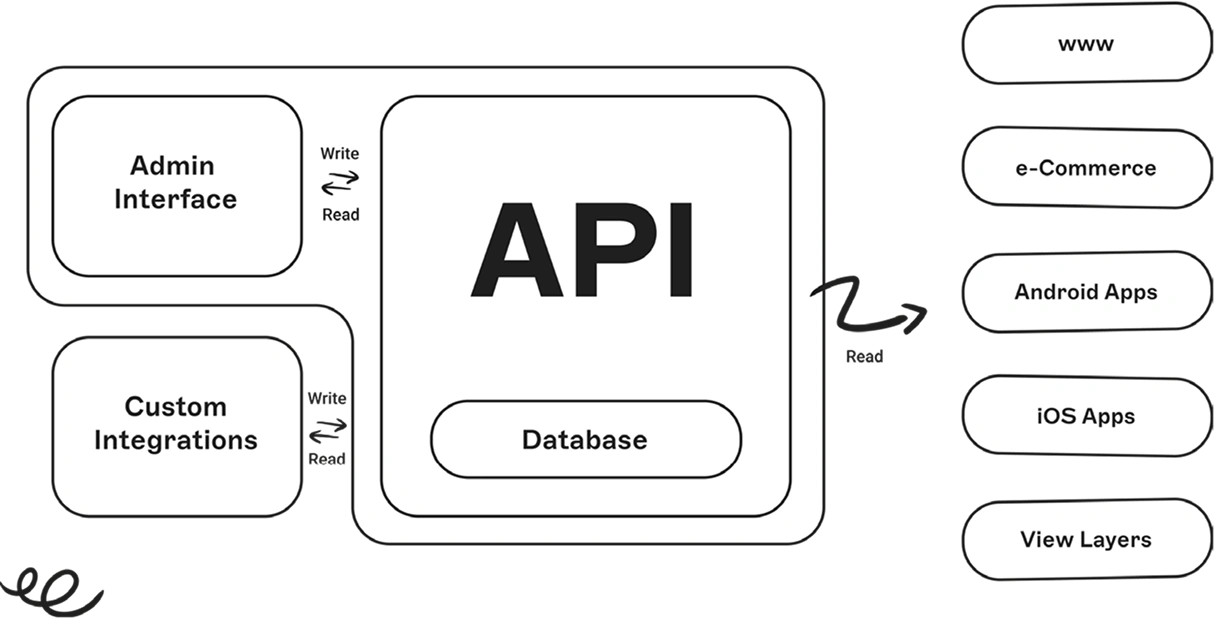
An example of headless CMS architecture
Just as cloud computing freed software from physical servers, headless CMS sets your content free from rigid presentation rules. It’s like content management finally had its “aha!” moment—separating what you want to say from how it looks on screen.
Think of a headless CMS as your content’s personal translator. Instead of squeezing your content into pre-made templates (talk about uncomfortable!), it keeps your content ready for anything. Your content becomes super adaptable, flowing smoothly into whatever channel you need, whether it’s a website, mobile app, VR experience, or whatever cool new thing pops up tomorrow.
This isn’t just another tech upgrade—it’s a whole new way of thinking about digital content. As Marshall McLuhan might observe, we’re moving from an era where the medium dictated the message to one where the message shapes its medium.
ASPECT
CHALLENGES
IMPACT
Marketer dependency
Heavily dependent on developers for template changes, feature additions, and bug fixes.
Minimal; marketers use pre-built components and workflows to create and manage content.
Developer dependency
Developers rely on marketers for content feedback, testing, and revisions during implementation.
Minimal; developers focus on building components and APIs, while marketers manage content independently.
Content creation workflow
Tightly coupled; developers and marketers must collaborate closely for even small changes.
Decoupled; marketers work independently with reusable components, reducing collaboration bottlenecks.
Development workflow
Developers often manage both technical updates and content integration.
Developers focus on scalable, modular systems without daily content-related interruptions.
Efficiency
Slower; mutual reliance creates bottlenecks
Developers focus on scalable, modular systems without daily content-related interruptions.
PART 4:
Storyblok: a headless CMS that melts the hearts of both marketers and developers
Remember the last time you saw a tool that made both your marketing and development teams smile? No? Well, you’re about to. Storyblok isn’t just another CMS—it’s like giving your teams a universal translator that finally lets them speak the same digital language.
Empowering marketers
REUSABLE COMPONENTS: YOUR CONTENT LEGO SET
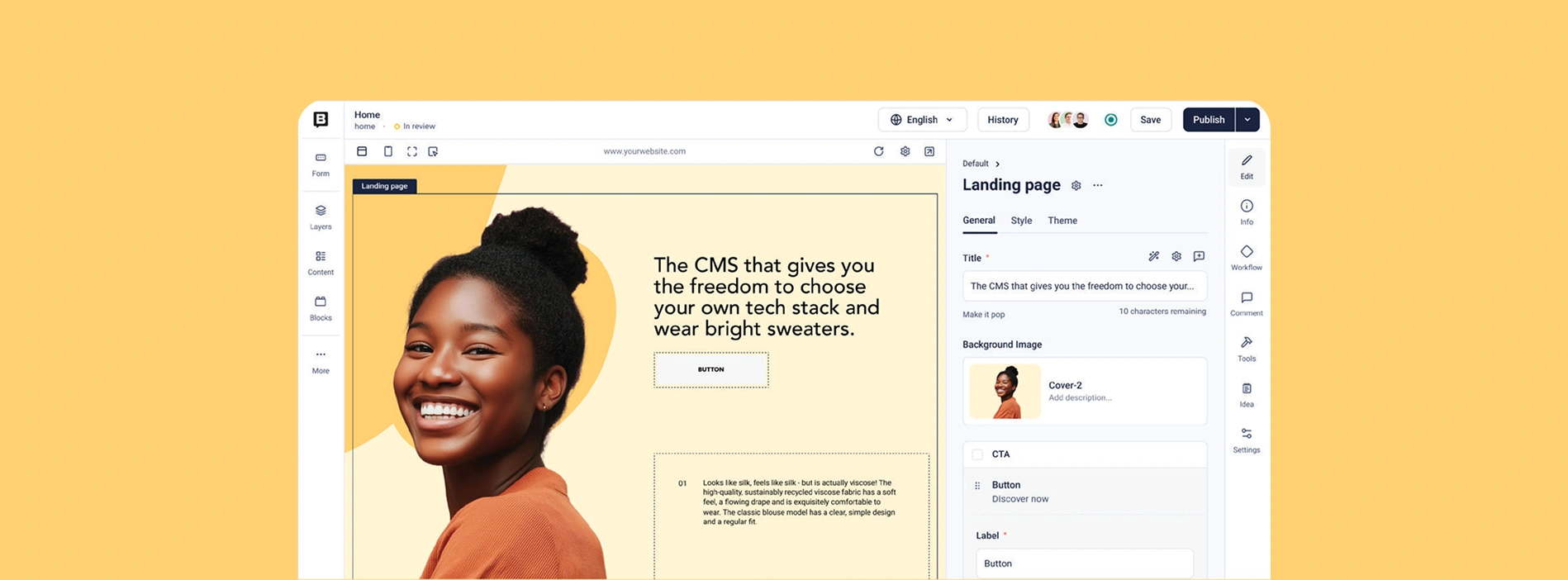
Gone are the days of rebuilding every page from scratch. Storyblok’s component system is like having a master set of digital building blocks. Once created, the component can be used and modified a million times – no need to recreate it each time. That stunning hero section you once requested? Save it, reuse it, remix it. Your content team just became architectural wizards, and they didn’t need to write a single line of code.
VISUAL EDITOR: WHAT YOU SEE IS ACTUALLY WHAT YOU GET
Remember that game of telephone between your design vision and the final product? Storyblok’s visual editor ends it. Edit in real-time, see changes instantly, and stop playing the “is this what you meant?” game with your development team. It’s like having X-ray vision into your final content before it goes live.
CUSTOM WORKFLOWS THAT ACTUALLY FLOW
Your approval process shouldn’t feel like navigating rush hour traffic. Storyblok’s custom workflows adapt to how your team actually works, not how some software engineer thinks you should work. Set up paths that make sense for your organization, and watch your content zip through approvals like a hot knife through butter.
VERSION CONTROL THAT HAS YOUR BACK
Made a mistake? No sweat. Every version of your content is safely stored, like a time machine for your digital assets. Roll back changes, compare versions, or experiment freely, knowing you’ve got a safety net that will always rescue you.
REAL-TIME COLLABORATION THAT ACTUALLY FEELS REAL
Comments, edits, and reviews happen in real-time, right where they matter. No more switching between twelve different tabs and four different tools. Imagine having your entire team in the same room, except nobody has to fight over the thermostat settings.


Freeing developers
EMPOWERED MARKETERS = LIBERATED DEVELOPERS
When marketers can handle their own content updates, developers can finally focus on what they do best: building awesome things.
BUILD YOUR PERFECT STACK (FINALLY!)
Remember being told “you can’t use that framework”? Those days are over. Storyblok plays nice with whatever tools make your developer’s heart sing. React? Vue? Astro? Yes, yes, and yes. It’s like having an API that speaks every programming language fluently.
MIGRATE AT YOUR OWN PACE
No need for dramatic “all or nothing” platform switches. Storyblok lets you migrate piece by piece, like updating your wardrobe one item at a time instead of setting everything on fire and starting over. Test, validate, and scale at a pace that won’t give your CTO heartburn.
CENTRAL MANAGEMENT, GLOBAL IMPACT
Update once, publish everywhere. Your content becomes a single source of truth, broadcasting across all your digital channels like a well-oiled media empire. It’s the difference between updating 20 different billboards and controlling them all from a single dashboard.
TRUE OMNICHANNEL PUBLISHING
Your content needs to live everywhere your customers are—web, mobile, IoT devices, digital signage, virtual reality, and whatever comes next. Storyblok makes this happen without making you rebuild your content for each new platform.
Be the next champion
The coolest companies say goodbye to rigid systems and make faster, bigger impact with Storyblok. You can do that too.


Conclusion: Breaking free from the legacy labyrinth
Let’s be honest—traditional content management systems (CMS) are like the flip phones you left behind years ago. They served their purpose in the past, but now they are relics of a bygone era, stifling creativity and hindering digital transformation. The constant struggle between marketers facing technical obstacles and developers overwhelmed by content requests is not just frustrating; it’s a drag on your entire business. Opportunities don’t wait, and neither should your team.
Switching to a headless CMS like Storyblok isn’t just an upgrade; it’s a much-needed revolution in how your organization operates. Marketers can reclaim their creative freedom, developers can focus on creating amazing experiences instead of constantly adjusting templates, and content can flow at the speed of your ideas. And it’s not a compromise; it’s unlocking innovation and leaving outdated limitations behind. The real question isn’t whether you’ll make the switch—it’s how much longer you can afford to wait.
About Storyblok
Storyblok is the headless CMS for marketers and developers who want to make bigger, faster market impact.
Developers thrive with the freedom to build better, faster, more flexible content experiences using their chosen tech stack. Marketers move with agility and independence, effortlessly editing, personalizing, and publishing content across every channel.
And customers? The seamless content experiences keep them engaged, delighted, and coming back for more.