

The Universal Trends and Benefits of Headless CMS

Defining the future
A frustrating user experience is a feature of monolithic CMSs, not a bug.
Think about it. How many times have you struggled with slow systems, inflexible technology, and little to no control over your content systems? It’s enough to tear your hair out.
It’s not a feature in the sense that those CMSs want you to be miserable and frustrated. The truth is that monolithic systems just weren’t built for the big leagues. It’s like playing baseball with a whiffle bat: you’ll never be able to hit a home run, no matter how good your swing is. The equipment is inherently limited for the job. And limited equipment limits you.
To see how different regions are tackling these restraints, we analyzed survey responses from 5 different countries. The results show incredible innovation to overcome unyielding monolithic roadblocks. They also point to one major strategy that promises to shatter them completely: headless CMS.
This report is for anyone frustrated with their CMS and looking for solutions. By understanding the most popular strategies for tackling CMS problems – and determining just how successful and sustainable they really are – we can figure out the best way to fully optimize our CMSs and raise the bar for our content experiences.
Or, as Confucius more elegantly put it: “To define the future, one must study the past.”
Let’s get studying.
Executive Summary

The USA relies heavily on WordPress (54%)… and struggles nearly as much with adding new technology (50%). The cost and effort of maintaining an ever-growing plugin library to compensate for that technical agility stings Americans, too.

The UK is embracing omnichannel distribution and all the benefits that come with. However, 65% have to use multiple CMSs to achieve it. The downsides of this fractured approach are apparent: working across multiple independent platforms and migrating final content to their CMS was flagged as the most difficult collaboration issue for the UK (cited by 49%).

Germany is practical and budget-focused, with high costs being the main reason for avoiding headless thus far (45%). Those who have already switched come bearing good news: 70% reported increased ROI, alongside other benefits including easier scaling/localization (58%) and time-saving/productivity improvements (40%).

The Netherlands relies on a high level of multi-team collaboration to create digital experiences. With 77% planning on changing CMSs soon, it’s safe to say traditional CMSs can’t handle this level of dynamic teamwork. The stunning 86% of headless users who reported increased ROI isn’t bad motivation to switch either.

Sweden is ahead of the curve, with 27% already using headless CMS. The first signs of improvement are already there: less reliance on multiple CMSs, fewer collaboration struggles, and a whopping 25% fewer recent migrations than the non-Swedish sample. Now that’s a tomorrow to look forward to.
Nobody can dispute WordPress’s market dominance, including the USA. The benefits of the system were revolutionary in the early days of the internet: easy to use, packed with premade templates, and built upon a system self-contained enough to be run by a single person. Back then, those were game-changers.
But then again, the first telephone was a tech marvel too, and we still invented smartphones anyway.
Our data shows that users from the States were some of the most likely to report they were using WordPress, over 54%. And if you zoom in on that 54%, a legacy-specific problem comes into focus: 50% reported struggling to add new technology to their tech stack.

Moreover, several Americans also conveyed their frustrations with a trademark WordPress feature: plugins. WordPress allows users to expand functionality from a list of (often community-maintained) add-ons. This means you get a lot of variety, but you’re also looking at problems such as security risks and complex backend maintenance.
Even if you’re willing to stomach those costs – which, according to our survey, many aren’t – that doesn’t solve the biggest plugin problem. WordPress was not designed to work on a massive scale, and the plugin structure reflects this. As you add tools and functionalities, the list of plugins you need to maintain and monitor grows exponentially
This crisis of requiring an ever-expanding, resource-intensive plugin list just to achieve the functionality you need isn’t limited to our study, either: WordPress users refer to it jokingly as the “plugin apocalypse”.
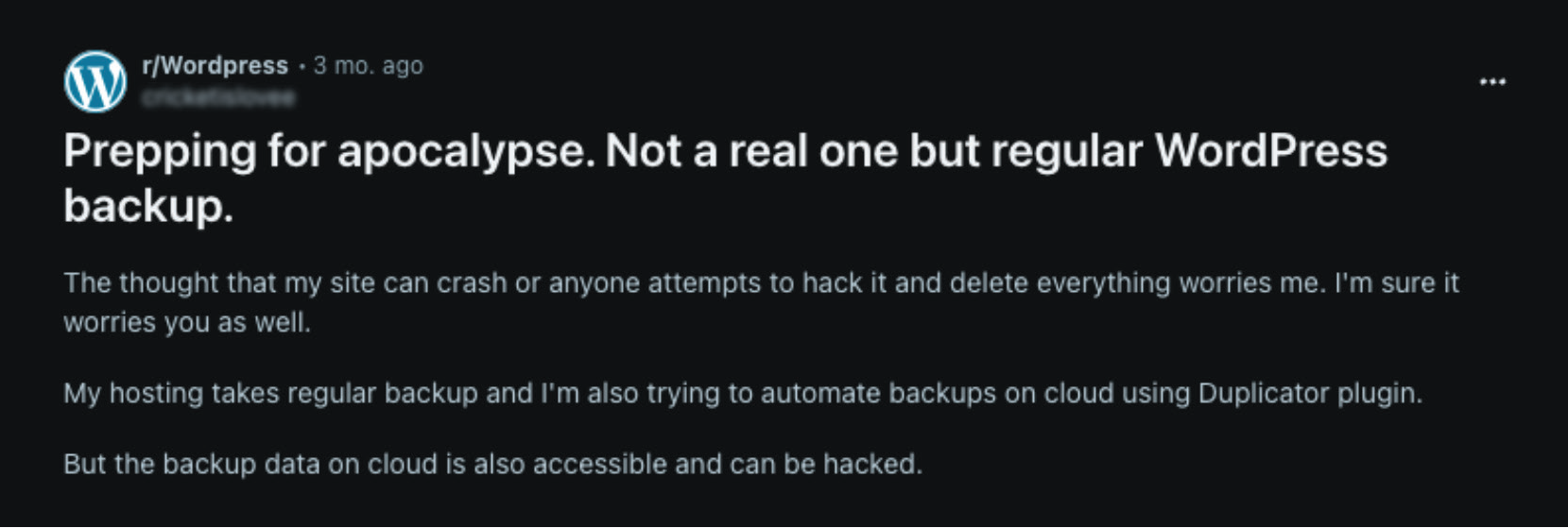
But every year it becomes a little more true and a lot less funny. You’re looking down the barrel of security issues, speed degradation, limited technological capabilities, and a great big headache. Outdated tech simply can’t keep up with the latest and greatest – and if you can’t let go of the archaic systems, you’ll be outpaced by competitors with more modern alternatives.
The need for headless among US users is clear, as is the growing unsuitability of WordPress (yes, even so-called “headless WordPress”) to meet it. Until they get a CMS that matches their ambition and potential, Americans may remain tethered to their systems like a landline to the wall.
As a species, humans are remarkably adaptable creatures. But we adapt to improvements just as easily as adversity. As technology has evolved to offer customers more from brands than ever before, we’ve come to expect a certain standard of digital experience. Features that were once “nice to haves” are now mandatory.
An example of this is omnichannel marketing. Nowadays, it’s the lifeblood of any digital presence. Customers have an endless amount of channels where they can interact with your brand: phones, desktop computers, laptops, smartphones, voice assistants, and even new horizons that are still being developed like AR/VR.
And that adaptation skill of ours means we’re not happy just to have that content available everywhere. On the contrary, our standards have risen to match the pace of innovation. Content has to be consistent, engaging, and personalized just to meet our basest standards.
Humans are funny like that.
Our data shows that the UK knows the omnichannel game better than most, but still struggles with the technology behind it. Of the UK users we surveyed, 65% of people who used more than one CMS did so to achieve omnichannel capabilities.

“By any means necessary” may be effective, but it’s rarely ideal. In the context of the UK it’s also a bit puzzling: the region was marginally more likely than the overall sample to favor newer omnichannel contenders like AR/VR, voice-activated speakers, and smartwatches. The UK also flagged working across multiple independent platforms and migrating final content to their CMS as the most difficult collaboration issue, affecting almost half of users (49%).
So, why does such a future-forward sample still hang onto monolithic CMSs that underperform? It’s simple: Upgrading is hard.
If you’ve ever shopped for a major appliance like a washing machine, you know the drill. The time, headache, and expense of buying a new system can be significant. It may promise shiny new benefits, but you won’t know for sure until it’s already in your house and you can’t undo the decision without even more stress. So even if your old machine requires you to bang the top three times and fiddle with the power cable, you might still decide it’s not worth the switch. As long as the clothes come out clean, right?
Well…
The problem is working with tech is a lot more complicated. For big, content-heavy organizations, you might have to go through the equivalent process every time you publish a blog, create a component, or launch a page. The time and trouble you spend looking for fixes will only scale as your content does. It’s what the Romans called a Pyrrhic victory – a hollow one with grave losses that is ultimately not worth the hassle.
So perhaps it’s time for the region to turn its eyes towards a victory that is worth the blood, sweat, and tears: headless CMS. The UK sample in particular reflects what an impressive investment headless CMS can be:

47% reported improved ROI

52% reported easier scaling and localizations

65% reported time-saved and productivity
Nobody’s saying that leaping into the future is easy. But it’s not exactly a leap of faith, either. The data shows that it’s a real investment into a better content experience for both brands and consumers – one our human brains won’t be forced to adapt to.
Budget restraints are an unfortunate but realistic part of choosing a CMS. This is especially true among our German sample: cost was the leading reason for not embracing a headless CMS among these users, with 45% stating the price was too high. But while a budget-conscious approach is crucial, it’s also important to remember that a CMS isn’t a one-off transaction. It’s an investment that, with careful leveraging, can lead to significant ROI.
This same region gives us data to support this conclusion. German users rated centralized content management and omnichannel capabilities as the most essential CMS feature – one they simply couldn’t live without. And yet, the same region overwhelmingly uses traditional CMSs like WordPress, which means they’re running into the same organizational issues as the users from the UK.
This isn’t even to mention the costs of not investing in future-proof tech. Being slower to market than your competitors and not being able to integrate emerging technologies are just the start. Perhaps worst of all, it means CMS users in this region are forced to contort ambitious content plans to fit the technical limitations inherent to such systems.
And it really is a legacy CMS limitation. Like the sample at large, most Germans were still not using a headless CMS. The technical jerry-rigging required to get the core functionality without a true headless system has fostered predictable issues:

54% of the region rated “lack of technical support” as a major roadblock when adjusting to a new CMS

43% complain about how difficult it is for non-technical users to make content changes
As for the German users who have switched to headless? It’s paid off, big time: 70% reported increased ROI, alongside other benefits including easier scaling/localization (58%) and timesaving/productivity improvements (40%). Only one person reported no benefits to headless.
Pratchett’s famous “‘Boots’ theory of socioeconomic unfairness” has endured for a reason. It’s not always fair, but it is true, and remains so even on the enterprise scale: investing now is cheaper in the long run.

Out of all others in the international sample, respondents from the Netherlands placed the highest value on teamwork:
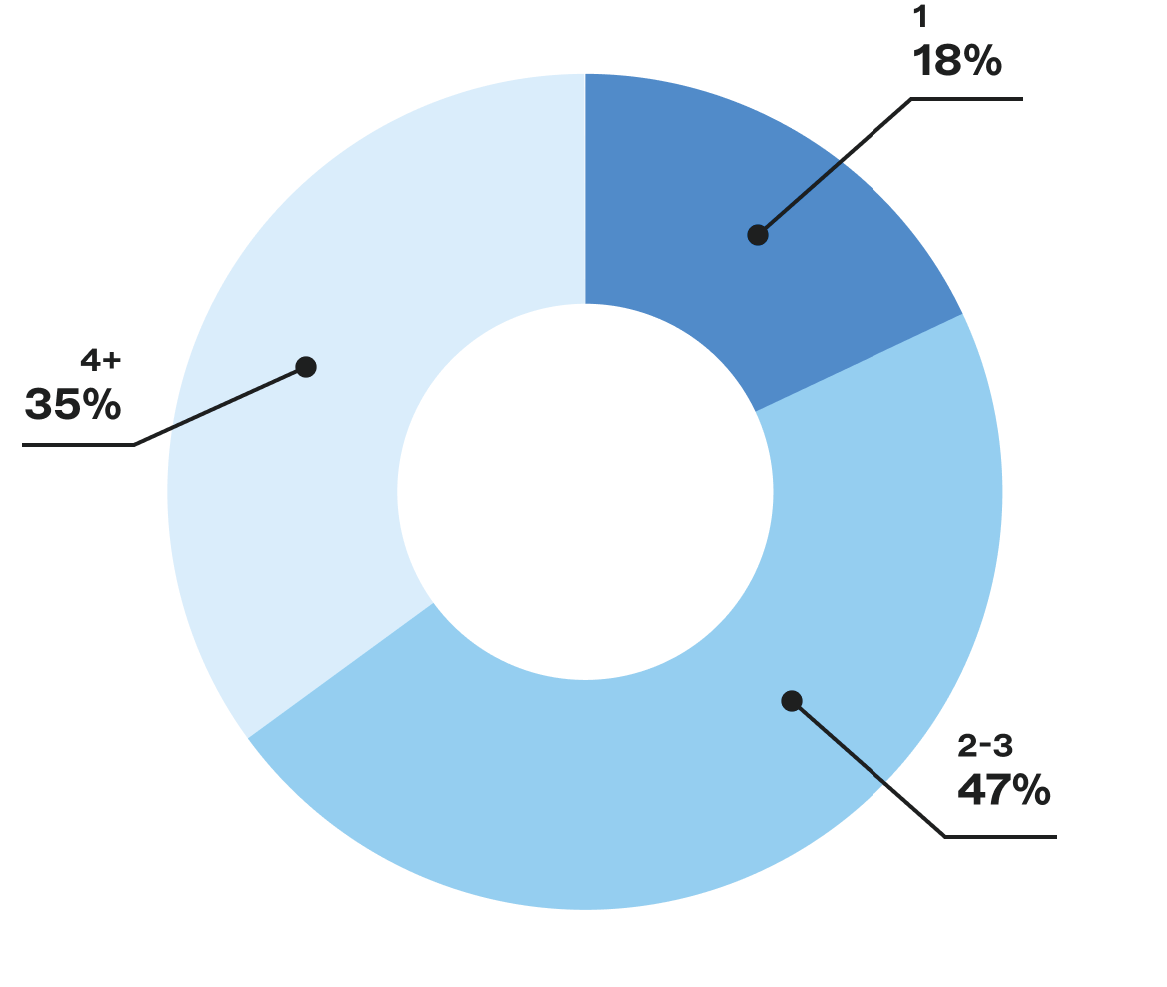
- 47% collaborate with 2-3 teams
- 35% collaborate with 4 or more teams
- Only 18% had just one team working with their CMS
In these multi-team endeavors, the departments involved run the gamut: marketing, finance, sales, developers, engineers, and more. It’s no wonder then that 51% of users in this region rated collaboration features as essential.
But despite the diverse user body and emphasis on its success, legacy systems are still letting Dutch users down. In the heavily monolithic sample, 43% reported non-technical users having difficulty with making content changes. Nearly a quarter (23%) flagged collaboration in general as a pain point they still struggled with.
Maybe that’s why a staggering 77% of Dutch users report plans to migrate to a new CMS in the near future. They may want to take a note from their headless-loving neighbors first, though. Those who switched to headless CMS reported high-level benefits, like the stunning 86% that reported increased ROI.
But no less important, headless also made it better for Dutch teams to work together on the everyday level, too:

36% experienced improvements in meeting their KPIs
48% reported easier scaling and localization
56% noted time-saving or productivity improvements
This sample is a snapshot of a region reflecting users who understand agile collaboration as a core tenant of successful content management. Perhaps it’s time to consider a system that’s worthy of their remarkable teamwork.
You might have noticed a not-so-subtle trend so far: companies who choose to switch to headless are choosing an easier, better content management experience for both external and internal users.
The Swedish respondents demonstrated the highest percentage of people already using headless CMS at 27% – over 1 in 4. While it’ll take a few more years to really see the true imprint of headless CMS in the region, it’s enough for us to start drawing early conclusions.
So, using Sweden as a case study, what does the data from the early adopters show us about the future of headless CMS in comparison to the rest of our sample? A world of promise:
% OF USERS WHO:
SWEDISH SAMPLE
NON-SWEDISH SAMPLE
Only need one CMS
22%
19%
Struggle with multiple independent platforms
38%
49%
Migrated in the last 3 years
45%
70%
The data shows us just a sample of the benefits that headless can offer. These are the first unmistakable signs that a region has recognized its advantages and is using them to fasttrack its content management to the future. The data for people who aren’t on that track yet in Sweden is pretty telling, too: the leading reason for not using a headless was not knowing enough about it (38%).
CMS users in Sweden should be proud. These tech trailblazers are leading the pack and becoming experts on the ever-unfolding potential of a headless CMS. As the early embers of headless spread, there’s every reason in the data to believe that those sparks will catch into a roaring fire.
Conclusion: A brighter tomorrow
So, how do the rest of us get on the same page as Sweden?
Good news: we’re already on our way.
Headless benefits, while more pronounced in some regions than others, are universal. Below is what our full sample of current headless users reported as their benefits since switching:
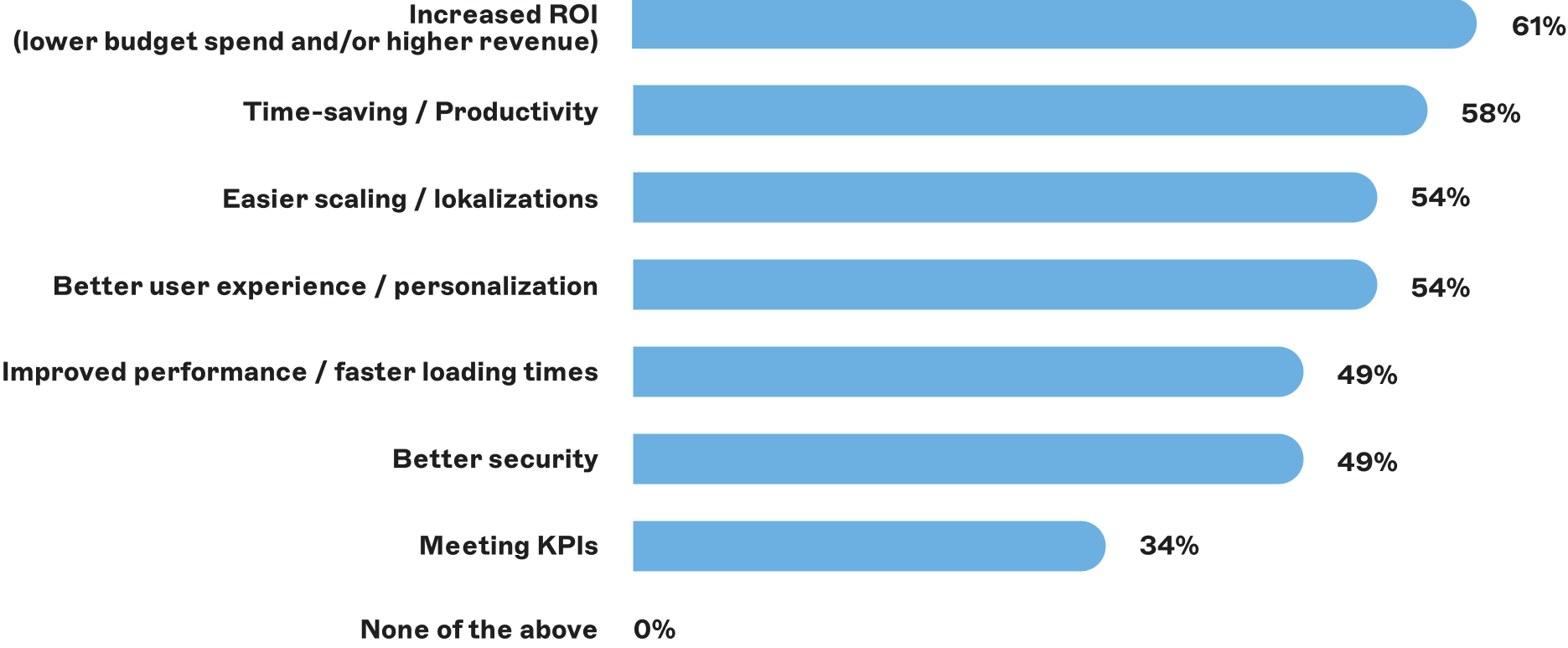
Only 2 people did not report improvements after using a headless CMS. To put that in perspective, barely 0.25% of the sample. Person after person found something about headless that helped to bring their brands into the modern digital age. Whether it’s making everyone’s lives a little easier with increased efficiency or boosting the ever-essential bottom line, headless has an impressive range of data-backed benefits to offer.
The days of struggling within the restrictive framework of legacy CMSs are over. Our global community stands on the brink of a content management renaissance. One that promises a better experience for developers and marketers, clients and customers, employees and CEOs.
Headless CMS is the future.
And, wow. What a bright future it is.
About Storyblok
Storyblok is the headless CMS for marketers and developers who want to make bigger, faster market impact.
Developers thrive with the freedom to build better, faster, more flexible content experiences using their chosen tech stack. Marketers move with agility and independence, effortlessly editing, personalizing, and publishing content across every channel.
And customers? The seamless content experiences keep them engaged, delighted, and coming back for more.