The CX mandate has changed.
Customer experience (CX) has never
been simple. Today, it’s integral to
business success, shaping cost
structures, brand sentiment and
revenue growth. The stakes are no
longer incremental. They’re existential.
What’s changed? Every interaction
is now benchmarked against the
best experience a customer has ever
had. At the same time, the rise of
agentic AI that can reason, act and
adapt autonomously is resetting
expectations for speed, personalization
and precision.
In the race to satisfy both customer
and boardroom expectations, a
common reaction, even among CX
leaders, is to layer best-of-breed AI
solutions onto existing channels.
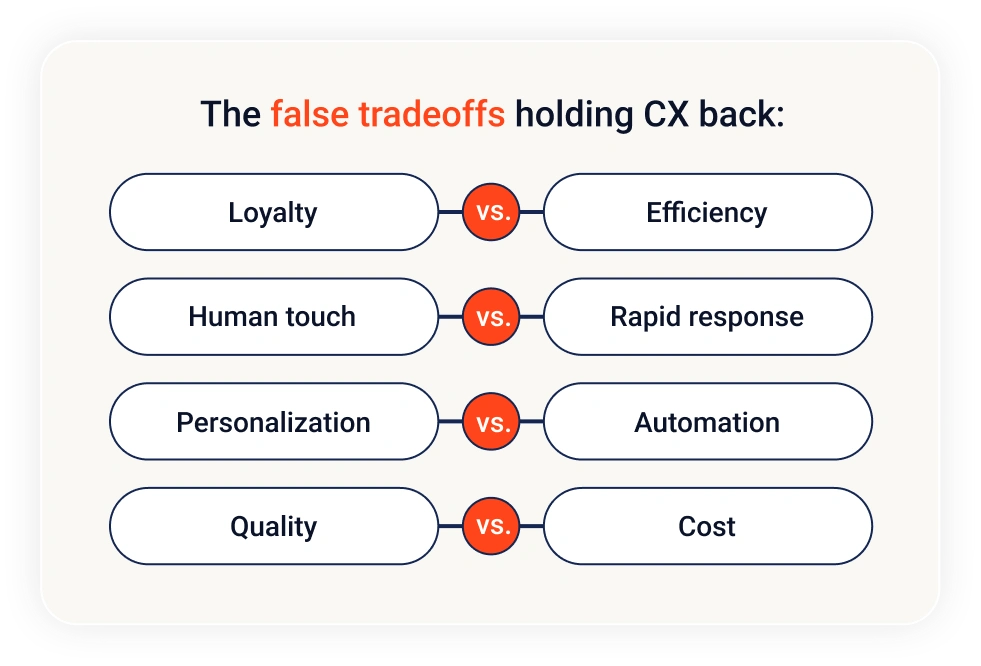
But here’s the hard truth: point solutions can optimize performance
or improve experience — but rarely
both — forcing organizations to choose
between operational efficiency and
customer loyalty.
Automation-first strategies drive
efficiency within individual interactions
but often fall short of delivering
outcomes across the journey.
Conversely, experience-first strategies
aim to improve satisfaction but can
be far too complex to scale across the
enterprise ecosystem.
This is the false tradeoff at the
center of modern CX. And it’s an
expensive one — increasing the risk of
fragmented experiences, operational
inefficiencies and missed growth
opportunities.
Leading organizations are rejecting this tradeoff,
driving both efficiency and loyalty to compound
results. They embrace a new operating model —
one that aligns people, processes, systems and
governance around delivering outcomes, not just
managing interactions.
By coordinating agentic AI across human
and virtual agents, channels and workflows,
organizations can accelerate operational
performance and orchestrate the consistent,
connected experiences that customers now
expect. This approach, known as agentic
orchestration, is the cornerstone of a new
operating model for autonomous CX.
And in today’s experience economy, anything less
is no longer a viable option.
From fragmented interactions to exceptional outcomes.
As enterprises deploy AI across complex tech stacks — CRM,
service, marketing, and more — each new layer of autonomy
introduces the risk of fragmentation. What begins as isolated
automation becomes a network of thousands of AI agents,
each one with new dependencies. Without coordination, those
dependencies collide — making the CX journey more complex,
less predictable and harder to manage.
But the agentic era also presents a clear opportunity: to
resolve customer issues proactively and intelligently by
orchestrating teams, workflows and decisions in real time.
Consider a common scenario: a customer flags a fraudulent
credit card transaction. The fraud detection, customer
service and account management systems operate in silos
— requiring the customer to call, verify details and follow up
across multiple interactions.
Agentic orchestration can eliminate that burden. The
system detects the anomaly, verifies the customer’s identity,
blocks the transaction, issues a replacement card, updates
the account and notifies the customer — all in a single,
coordinated flow.
The experience is proactive, empathetic and contextual, driven
by the customer’s intent and desired results.
To deliver exceptional outcomes at scale, CX leaders must
move beyond automating individual interactions and begin
orchestrating holistic experiences. When applied across
the business, agentic orchestration helps break down
silos, remove friction and fuel customer retention to drive
measurable business impact.
Three plays are essential to making this shift:
- Orchestrate experiences with responsible AI
- Coordinate work between human and AI agents
- Unify systems across the enterprise
 Play #1
Orchestrate experiences with responsible AI.
AI is rapidly moving beyond generative, deterministic conversations
powered by large language models (LLMs) to large action models
(LAMs) that can plan, execute and verify work across systems. As
a result, AI is no longer limited to responding; virtual agents and
copilots can now reason, act and adapt to complete outcomes with
speed and precision.
But action alone is not enough. Without coordination, even the most
capable AI agents operate in isolation — limiting their ability to
deliver consistent outcomes.
The true value of agentic AI is realized when it operates within an
orchestrated system where humans and AI agents are guided by
shared data and memory throughout the customer journey. In this
environment, AI understands the full customer context and intent —
adapting in real time to take action.
What agentic AI should provide:
- Autonomy and adaptability
- Coordination across agents and systems
- Persistent context and memory
- Governed and auditable decision making
- Resilient infrastructure
- Operational accountability, even under peak demand
As CX becomes more autonomous, the need to safeguard
customer trust becomes increasingly important. AI must
operate within clearly defined guardrails aligned to the
business. This means decisions are governed, not just
generated; actions are controlled, not just automated; and
outcomes are accountable, not just optimized.
When natively embedded in a compliance-first, enterprisegrade platform, agentic AI becomes a controlled, auditable
system that can mitigate risk, protect data integrity and
scale without introducing unintended cost or exposure.
 Takeaway
Agentic AI creates value when it operates
responsibly, within an orchestrated system using
shared context and governed autonomy.

“The democratization of AI is going to
be agentic. Customers will ask AI to
perform a range of tasks, and it needs to
orchestrate their experience, amplify the
human agents involved, and deliver on
your organization’s promises and goals.”
Trevor Schulze
Chief Information Officer, Genesys
 Play #2
Coordinate work between human and AI agents.
The most effective organizations aren’t using AI solely to
reduce headcount — they’re using it to redesign how work gets
done. And the role of human agents is changing altogether.
As AI takes on more responsibility, human involvement
becomes more intentional and less incidental — determined in
real time based on complexity, context and customer needs.
Instead of filling process gaps or searching for context, human
agents guide outcomes, applying judgment, empathy and
oversight at the moments that matter most.
Capabilities like predictive routing, virtual agents, and copilots
are no longer standalone tools — they become components of
a broader orchestration layer that coordinates work between
teams and AI.

This is not just a hybrid AI-human workforce — it’s an
orchestrated system where human and AI agents work
together toward shared outcomes.
AI operates at scale across the organization while humans
provide direction, governance and accountability to ensure
resolutions are delivered consistently and responsibly.
Equipped with full context and continuous learning, human
and AI agents work together to improve performance across
the entire customer experience.
Takeaway
Leading organizations design a coordinated
hybrid workforce where AI executes at scale and
humans guide, govern and elevate outcomes.

“Agentic AI brings knowledge out of the
cracks and crevices of an organization
and delivers it to the human agents and
digital workforce.”
Mike Szilagyi
General Manager, Product Management, Genesys
 Play #3
Unify systems across the enterprise.
Customer journeys don’t exist within a single channel. They span the
full lifecycle, from awareness to purchase to retention and beyond.
Yet many organizations still rely on disconnected tools to manage
interactions across systems, channels and processes.
A unified platform enables orchestration by capturing signals across
the entire ecosystem and turning them into real-time intelligence. At
its core is a data foundation that transforms every interaction into an
evolving understanding of the customer — carrying context, intent,
and memory forward throughout the journey.
This is what allows organizations to anticipate needs, diagnose
issues and adapt in the moment.
For end-to-end journey management to work, data must do more
than connect. It must persist. When data becomes intelligence — and
intelligence becomes memory — the system can retain what has
happened, understand what matters and apply it continuously. AI
agents and teams operate with shared context, reducing friction and
enabling faster, more precise decisions.
This is what separates integration from orchestration.
A unified platform doesn’t just connect tools — it aligns
information, decisions and actions into a single system of
execution. In this model, AI moves from responding to acting
— coordinating work across channels to complete outcomes
that align customer needs with business goals at scale.
Takeaway
A unified, open platform enables orchestration —
connecting data, systems and channels across
the enterprise with persistent memory and
continuous learning.

“Done well, strategic CX transformation
delivers measurable impact — improving
operational efficiency, increasing brand
equity, accelerating revenue growth and
strengthening long-term customer loyalty.”
Scott Cravotta
Director de Clientes, Genesys
It’s time to rethink your CX operating model.
No longer a future state, the path to autonomous CX is clear. For
enterprises, the challenge is not just adopting more AI, but making it work
cohesively, responsibly and at scale.
Success in the agentic era requires a fundamental shift: from managing
interactions to delivering outcomes; from isolated automation to
coordinated decisions; and from disconnected tools to unified execution.
Agentic orchestration is the coordination layer driving this shift. Every
interaction works toward a shared resolution — enabling seamless end-toend customer experiences.
This doesn’t happen with AI alone. It requires a unified platform designed
to make intelligence actionable across the enterprise.
Genesys Cloud™ is the open, unified platform powering this AI
transformation. It brings together agentic AI, orchestration, data, and
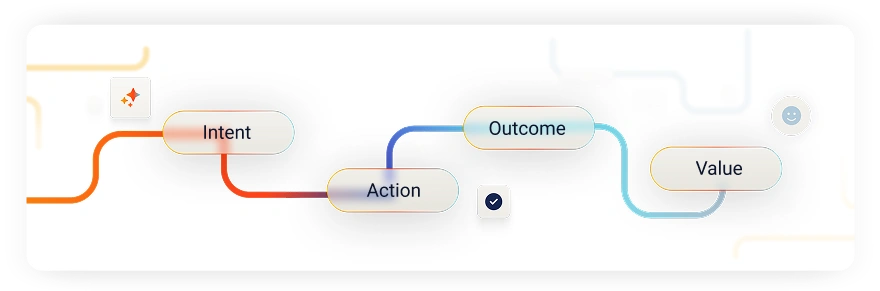
governance into a single system — turning customer intent into coordinated
action at every moment.
With Genesys as a trusted partner, organizations
that adopt a new operating model for autonomous
CX aren’t just delivering better experiences —
they’re creating a compounding advantage that
improves efficiency, reduces costs and builds lasting
customer loyalty.
That’s CX done right.
See how Genesys Cloud enables AI-Powered Experience Orchestration at scale.
Watch the demo
Trustworthy AI,
purpose-built for CX
 AI that independently supports customers and
agents — all within your determined guardrails
AI that independently supports customers and
agents — all within your determined guardrails
Intelligent coordination
across the full
customer journey
Agentic virtual agents that reason, act and
adapt to deliver outcomes at enterprise scale
A unified platform
that connects data,
systems and AI
Seamless integrations that enable
orchestration and execution in one proven
platform
A trusted partner with
the expertise to navigate
the agentic era
Over 25 years of experience working with more
than 8,000 customers to build CX that grows
and keeps loyalty for life
About Genesys
Genesys® empowers more than 8,000 organizations worldwide to
create the best customer and employee experiences. With agentic
AI at its core, Genesys Cloud™ is the AI-Powered Experience
Orchestration platform that connects people, systems, data
and AI across the enterprise. As a result, organizations can
drive customer loyalty, growth and retention while increasing
operational efficiency and teamwork across human and AI
workforces. To learn more, visit www.genesys.com