



Agentic AI is changing the future of CX
Introducing Genesys Cloud Agentic AI
Whether you're fine-tuning agent performance or extending automation to new areas of your business, Genesys Cloud™ AI Studio and Genesys Cloud™ AI Guides give you the tools you need. These new capabilities in Genesys Cloud are built to scale with you — without adding complexity.
Drive better customer experience across every conversation with:
-
Genesys Cloud™ AI Studio
Give your team a single place to build, configure and manage artificial intelligence (AI), enabling consistency, control and scale.
-
Democratized AI innovation
Empower your teams — even those without coding experience — to build AI, helping to accelerate innovation across your organization.
-
Safe, responsible AI delivery
Help ensure every experience is aligned with your brand, policies and standards using built-in guardrails and oversight.
-
To find out more visit Genesys.com/Capabilities/AI-Studio

Genesys empowers organizations of all sizes to improve loyalty and business outcomes by creating the best experiences for their customers and employees.
Through Genesys Cloud, the AI-Powered Experience Orchestration platform, organizations can accelerate growth by delivering empathetic, personalized experiences at scale to drive customer loyalty, workforce engagement, efficiency and operational improvements.
Visit us at www.genesys.com or call us at +1.888.436.3797.
When you’re ready, Genesys Professional Services experts are available to assist in your AI transformation, contact us or request a demo.
What is Agentic AI?
The term “agentic AI” is appearing everywhere, so it is best to start this study of how it can be used in the contact center environment to specify what we actually mean by this.
At the top level, “agentic AI” refers to systems capable of taking autonomous actions toward achieving a defined goal.
Unlike traditional bots or static automation, agentic AI behaves like a digital employee: planning, executing and adapting tasks across systems without constant human instruction.
True agentic AI exhibits specific characteristics:
- Autonomy: operates without human prompting once goals are set
- Goal-oriented: acts to fulfil specific objectives (e.g. resolve a billing dispute)
- Initiative-driven: proactively takes steps rather than waiting for input
- Adaptability: learns from outcomes and adjusts strategies accordingly
- Tool-using: interfaces with other systems such as CRM, ticketing platforms and databases as necessary.
Evolution of AI in the Contact Center
The use of AI in the contact center has come a long way, very quickly.
The term “Artificial intelligence” is used very loosely by industry commentators, solution providers and organizations, so much so that it now seems to cover almost every use of technology in the contact center.
Looking at the use of “AI” in the widest sense, we can see where agentic AI fits in:
-
1: Rule-Based Automation
- Simple scripts and decision trees (IVRs, chatbots with limited flows)
- Human escalation required for anything outside preset rules
- Considerable usage and success with handling simple web chat
-
2: Conversational AI
- Natural language understanding (NLU) enables more dynamic dialogues
- Still reactive and largely dependent on structured interactions
-
3: Generative AI
- LLMs (large language models) generate responses, summaries and content
- Greatly improves knowledge retrieval, but lacks task autonomy
-
4: Agentic AI
- Combines conversational and generative capabilities
- Adds autonomous decision-making, action execution and planning
- Represents the shift from automation to true autonomy.
Why are US organizations implementing AI (of any kind)? Conventional wisdom says that it is to reduce the cost of paying salaries and while there is almost certainly an element of this, it does not seem to be the primary motive.
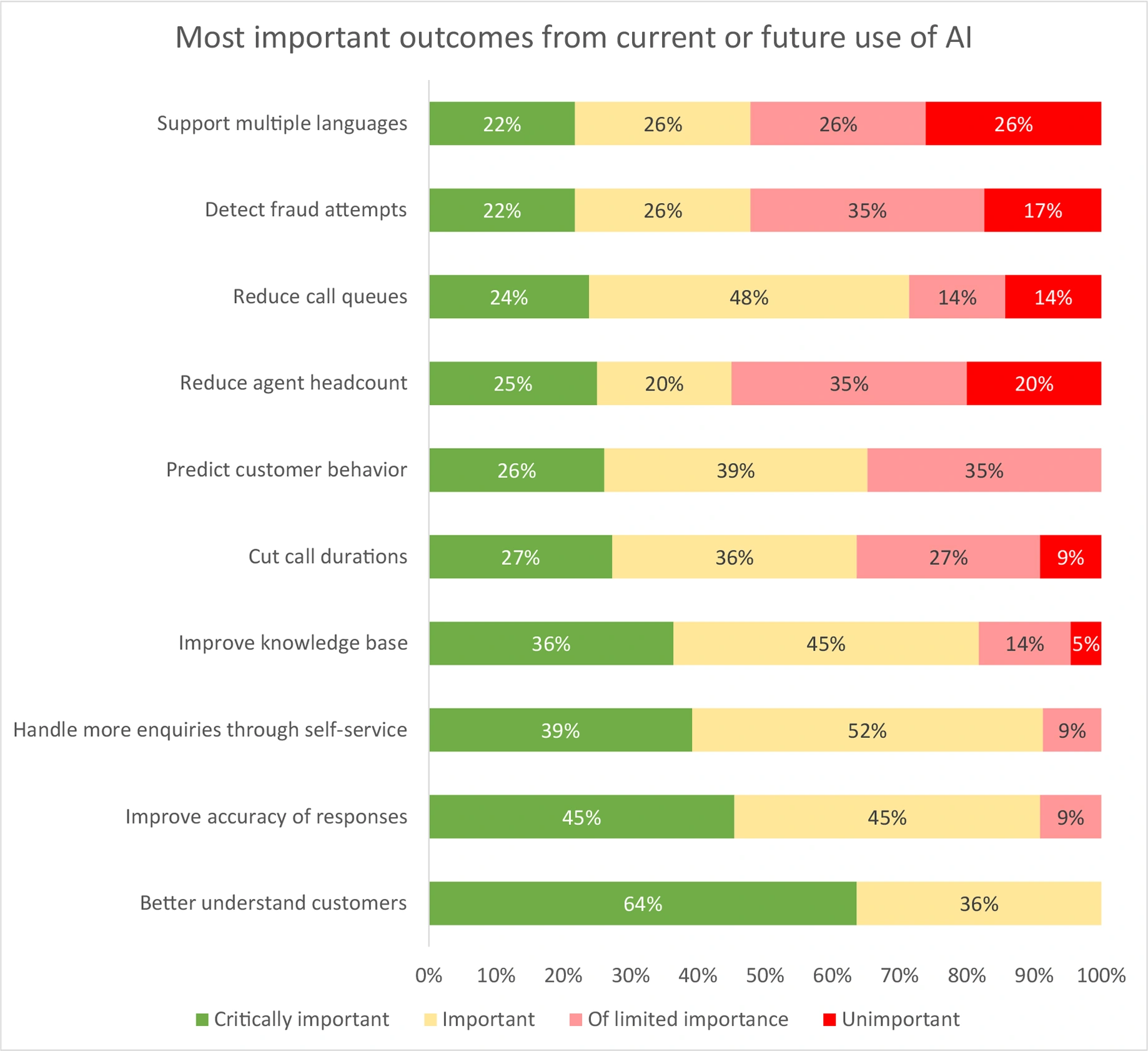
In fact, while 25% of US contact centers said that reducing agent headcount was of critical importance to them, 55% said that it was of either limited, or no importance.
AI is looked upon to be vital as a means to increase the sophistication, accuracy and effectiveness of self-service, and also as a way to improve the understanding of customers.
The improved provision of information — quicker and more accurate — across all channels is also a key driver of AI implementation.
Improving telephony operational performance through reduced call lengths and queue times is seen as less important, despite the powerful effect this can have on customer experience.
It should be noted that although headcount reduction is one of the least popular of the options provided, the large majority of the reasons for implementing AI could actually lead to this.
For example, the benefits from successfully cutting call duration could lead to shorter queue times with the same number of agents employed. However, it could alternatively lead to reduced headcount if no improvement to queue performance KPIs were desired.
AI produces efficiencies, and it is then up to the organization to decide what to do with them.
How Agentic AI Works
Agentic AI is not simply a more advanced chatbot. It represents a fundamental shift in the way AI systems operate, moving from reaction and content creation to autonomous task execution.
This section explains how agentic AI works at a system level and how it compares to other common AI types in contact centers: conversational AI and generative AI.
Agentic AI operates as an autonomous system capable of pursuing objectives, making decisions and acting across tools and environments.
Its architecture includes several interlocking components:
- Goal Definition: AI detects the user's objective from input (text, voice, or API) using natural language understanding (NLU) or intent recognition. For example, from the query “I was charged twice for my last order,” the AI identifies a goal: resolve billing discrepancy.
- Planning & Reasoning: the system formulates a multi-step plan to reach the identified goal. It then uses planning algorithms or reasoning frameworks to determine the necessary steps and their sequence. For example, Authenticate > Retrieve order > Check duplicate payment > Process refund > Notify user > Log action.
- Tool and API Integration: agentic AI interacts with external systems such as CRM, billing platforms and scheduling software via APIs in order to complete tasks. Unlike chatbots, which only surface information, agentic systems execute transactions and modify data.
- Execution and Orchestration: executes each step in real-time, adjusting as needed. It may operate across channels and touchpoints as required.
- Feedback Loops and Learning: outcomes are monitored and strategies adapted based on success/failure signals, which can incorporate user feedback (e.g. satisfaction scores or complaints) to retrain components or adjust workflows.
- Human-AI Collaboration: agentic AI knows when to escalate, pause or request human validation through configurable confidence thresholds or if certain conditions are triggered, enabling Human-in-the-Loop (HITL) interactions for critical steps.
Agentic AI differs from conversational and generative AI in numerous ways, including autonomy, outputs, planning ability and use cases.
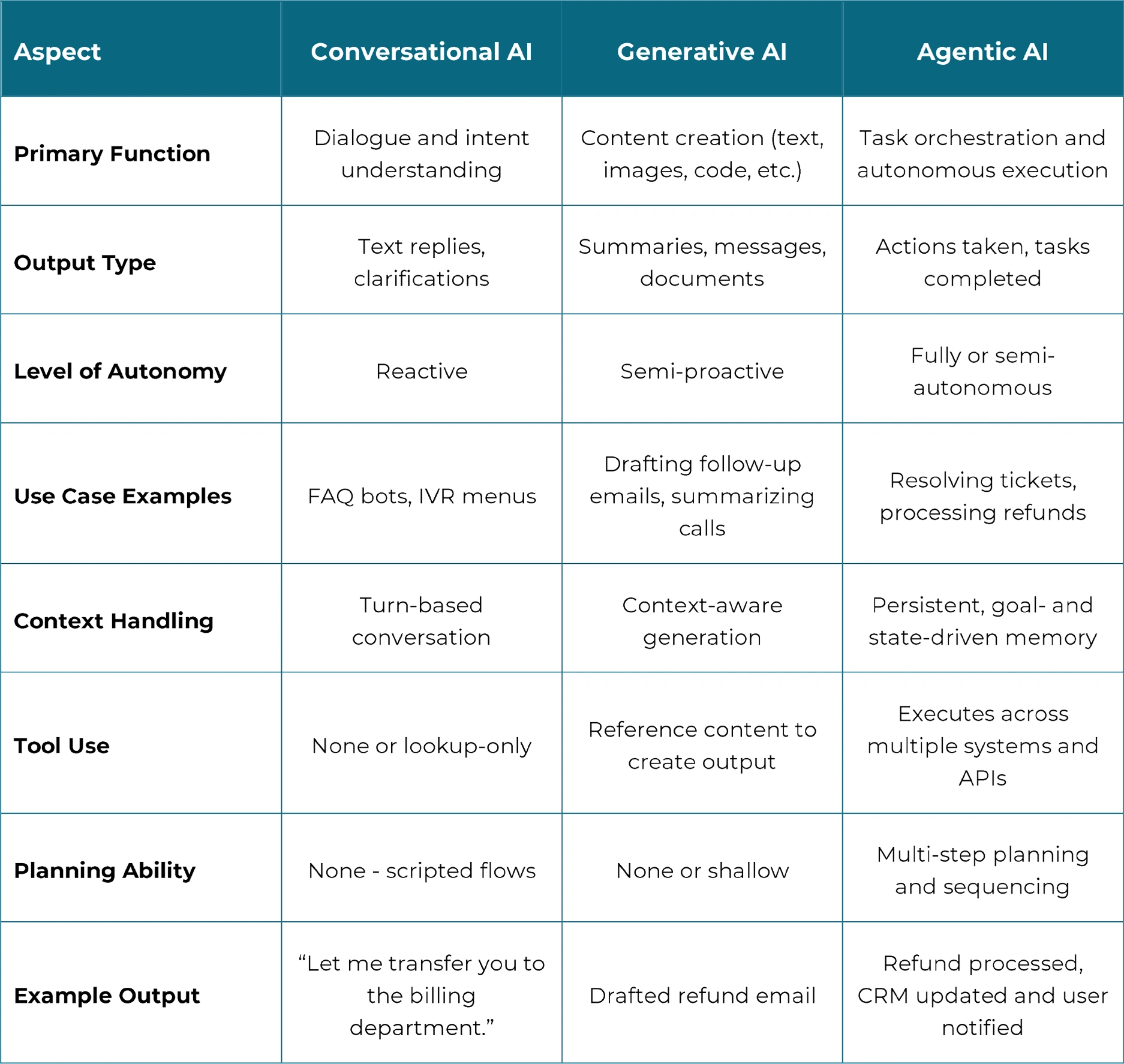
Agentic AI Characteristics
Agentic AI is the next evolutionary step in contact center automation, going beyond understanding and responding.
Agentic AI systems plan, decide, act and learn, differing fundamentally from conversational and generative AI in that the AI agent doesn’t just speak or write, it actually gets things done, autonomously and across systems if necessary.
Some elements of agentic AI include:
- System Integration: operates across multiple tools and APIs, taking actions such as issuing refunds, rescheduling appointments or updating records.
- Collaboration and Delegation: co-ordinates with other agents or human workers, using confidence thresholds to decide when to self-resolve or escalate.
- Planning and Sequencing Actions: agentic AI maps out the steps required to reach an objective, for example, authentication, followed by data retrieval, followed by policy application, resulting in a resolved issue.
- Environment Reasoning: understands the status of external systems and conditions (such as service outages or calendar availability), adapting its strategy if tools or data sources are unavailable. For example, if the CRM system is down, AI can route the interaction to a human agent or log a task to retry later.
- Error Recovery: detects failures in the workflow and tries to reroute, escalate or retry as appropriate (e.g. if payment processing fails, AI can retry with a backup system or alert a supervisor).
- Agent Coordination: in multi-agentic systems, AI agents assigned to different domains (billing, tech support, sales), collaborate with each other, passing on data, sharing task ownership and aligning goals. In a multi-agentic environment, a billing agent may confirm refund eligibility and then pass the case to a compliance agent for policy review.
- Persistent Memory: stores knowledge across sessions and interactions, enabling personalization and continuity (e.g. remembering a customer’s preferred callback time from a previous session).
Agentic AI Deployment Models
Industry deployments of agentic AI typically fall into one of these operational models:
- Monolithic Agent: a single agent handles tasks end-to-end. This is simpler to deploy, but by definition less modular and harder to scale across roles.
- Planner / Executor Model: while one agent plans, others execute subtasks. This model is more flexible and allows targeted optimization.
- Multi-Agentic Systems: this model uses multiple specialized agents, operating like a digital team. It is modular, scalable and ideal for complex, high-volume environments (e.g. telecoms or healthcare). For example, one agent handles customer authentication, another processes refunds, while a third manages compliance logging.
- Human-AI Hybrid: combines automation with human oversight at checkpoints. It is currently the most common enterprise deployment model, balancing risk, control and efficiency.
Regardless of deployment model, there is a great emphasis on “Governance First” agentic AI deployments, which aims to protect customers, data and trust. There is a section later in the report that looks at this.
Responsible Agentic AI at Scale
Today's virtual agents often rely heavily on technical resources and predefined conversation flows, making them rigid and sometimes struggling with the complexity of real-world scenarios. The evolution toward agentic AI introduces greater autonomy, enabling virtual agents to dynamically adapt and make decisions independently. While this advancement can significantly enhance customer experiences, it also raises critical governance concerns, as the decisions of these virtual agents can impact customer loyalty and brand reputation.
At Genesys, we're helping to address these concerns with Genesys Cloud™ AI Studio and Genesys Cloud™ AI Guides, empowering organizations to confidently leverage the next wave of intelligent virtual agents through an accessible, no-code interface. With AI Guides, organizations can easily create and deploy more advanced virtual agents capable of reasoning and acting more autonomously within defined guardrails. AI Guides help brands move virtual agents beyond handling simple transactional interactions, allowing them to effectively manage intricate, multistep engagements, trigger comprehensive enterprise workflows, collaborate seamlessly across human and AI teams and navigate high-stakes customer interactions responsibly.
AI Guides simplifies the creation and deployment process by offering:
- Natural language, no code required: Teams can build or refine intelligent agents using plain language or existing documentation, reducing the need for specialized coding expertise.
- Build once, deploy anywhere: Streamline operations by designing experiences once and deploying across virtual agents, copilots and more.
- Enterprise-grade collaboration: AI Guides facilitates integration across front-, middle- and back-office systems to automate complex workflows and help achieve business outcomes.
- Built-in guardrails: Configurable and testable controls help ensure virtual agents maintain privacy, tone and compliance with organizational policies, powering responsible and trustworthy AI deployment.
AI Guides leverages a flexible, model-agnostic architecture, enabling continuous testing, iteration and improvement as new models become available. Powered by the robust Genesys Cloud platform, organizations have the flexibility to adopt and adapt AI solutions that align with their evolving business goals, while maintaining oversight, safety or performance.
Use Cases for Agentic AI
Agentic AI extends far beyond static chatbots or reactive assistants, acting as an autonomous agent that understands goals and executes across systems, adapting in real time to achieve optimal outcomes.
The following agentic AI use cases are categorized into three pillars: live agent assistance, customer self-service / digital channel support and analytics / compliance.
AI-Enabled Live Agent Assistance
AI offers great opportunities for a reduction in talk time and therefore cost and queue length reduction, without negatively impacting customer experience or outcomes.
The following chart shows the long-term rise in call duration.
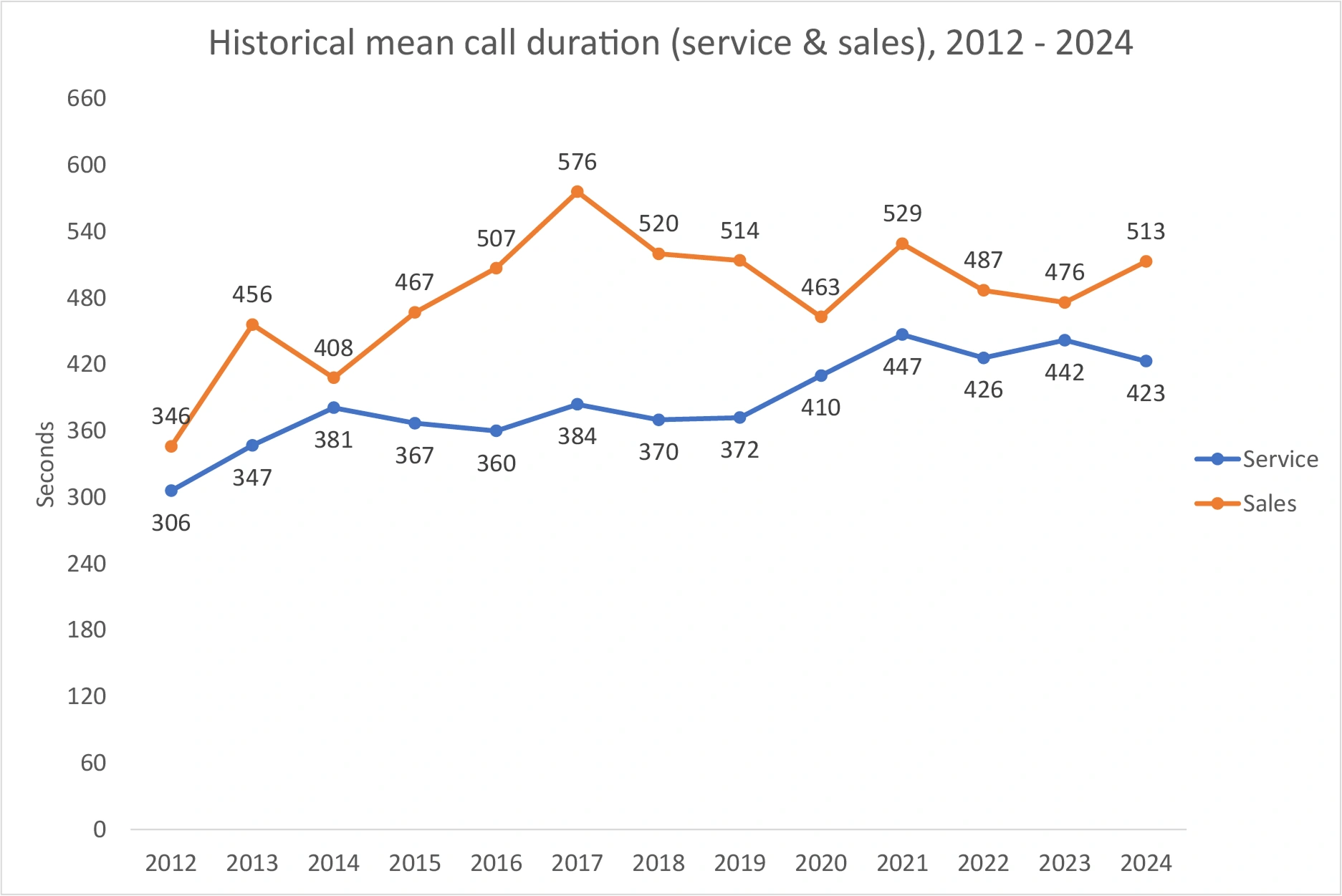
Call duration is a less important metric now than historically, as contact centers have allowed call times to increase as customer experience becomes more important and self-service takes up a greater proportion of the easier short calls.
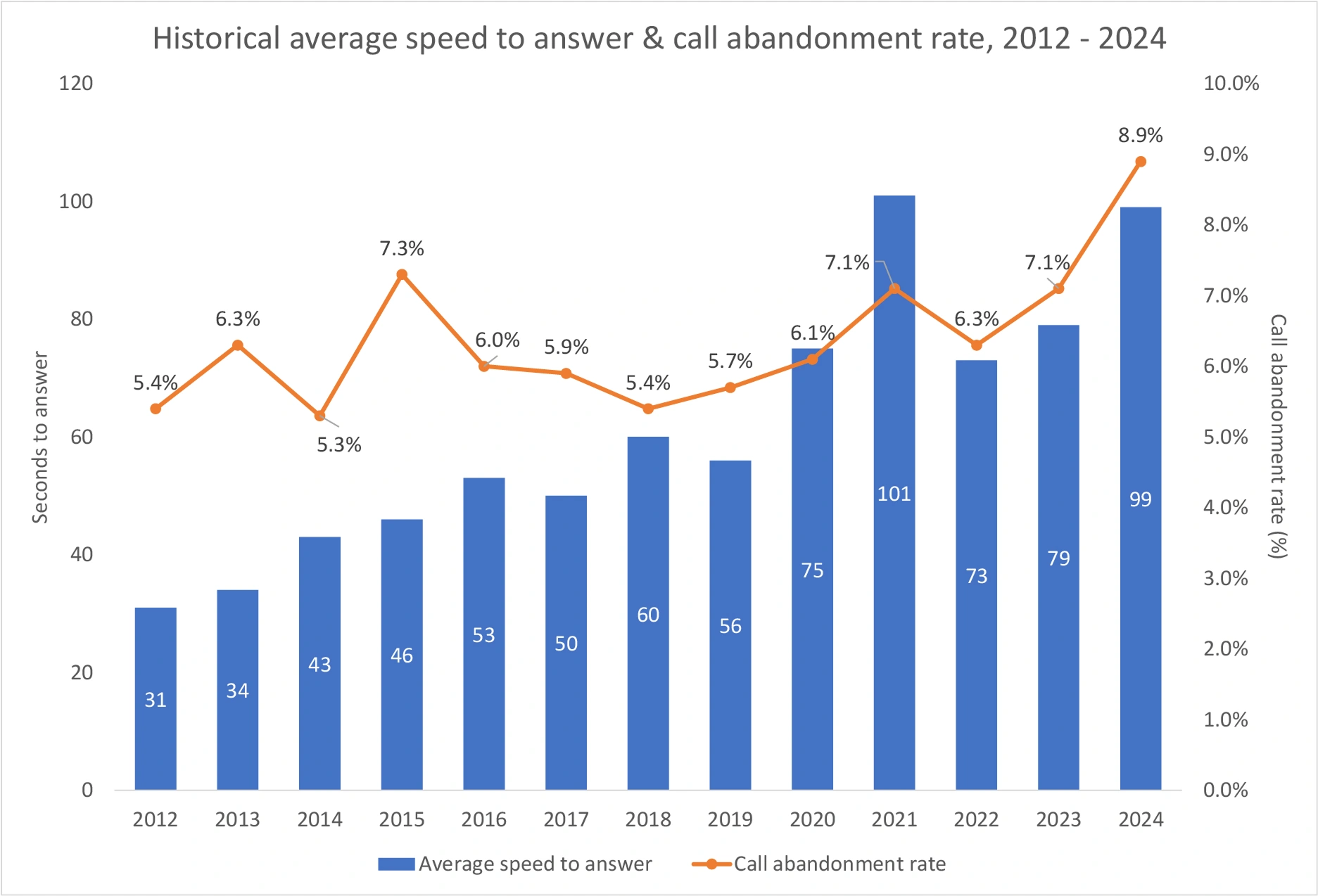
However, queue lengths impact greatly on customer experience: if agents are talking to customers for longer, they can’t be taking new calls.
Driven in part by these longer calls, the following chart shows average speed to answer and call abandonment rate, both of which have a discernible impact on CX, sales opportunities and cost.
Agentic AI can trim time and money which is currently wasted by:
- searching for the right information
- accessing multiple applications and screens
- pauses for agents to type
- long and inaccurate post-call work.
Finding the right information
AI can provide the agent with suggestions about next best action, pull up relevant information from the knowledge base, make suggestions based on customer history and sentiment about optimal cross-selling and upselling opportunities, and even the style of conversation that this customer may prefer.
Apart from cutting down on wasted time, this also has a positive impact on first-contact resolution and customer experience. This is of particular use to less experienced agents and for unfamiliar subject areas.
Agentic AI monitors the real-time desktop and voice data, triggering processes such as information provision and back-office processes. It then executes back-end actions on behalf of agents.
For example, while the human agent continues the conversation, the AI agent can be issuing a refund or updating an address driven by what’s happening within the conversation. This reduces cognitive load on the human agent, as well as cutting call durations.
It can also provide coaching or alerts if there’s a lengthy pause in the conversation or anything has been done wrong. Agents can also use specific phrases, such as “I’ll just look that up for you”, triggering the AI assistant to take action and putting the information on a single agent desktop application.
This contextual knowledge retrieval gathers relevant knowledge base articles or historical case data based on live conversation and surfaces step-by-step guidance tailored to the current interaction. For example, if the agent is talking to a long-term customer, the AI agent can show their loyalty tier and policy exceptions without the human agent having to search for it themselves.
AI can work alongside agents to provide relevant knowledge that may be otherwise take a long time to find. It can also update the knowledge bases available to humans and AI self-service systems using an automated feedback loop that is constantly improving based on actual outcomes. It’s also important to note that agentic AI assists across multiple channels, suggesting actions in one channel while completing tasks in another (e.g. sending a confirmation email during a live chat).
Accessing a single screen
Many of today’s contact centers use complicated, multiple applications, often only loosely linked, which require skilled and experienced agents to navigate, let alone to manage interaction with customers successfully at the same time.
In most cases where complex, multiple applications are used, they are necessary for the agents to do their job, so the question is not “How can we reduce the number of applications?”, but rather “How can we improve how the agent uses the applications?”.
At the moment, due to complexity, expense and the sheer weight of constant change, applications are either integrated very loosely, or not at all. Agents are trained (or more likely, learn on the job) to switch rapidly between applications, relying on their experience to make sure they don’t forget to do what’s required.
Many contact centers still rely on information held in legacy systems. Agents use an average of 3.4 applications within a call and 2.3 post-call, which leads to considerable amounts of time being spent — especially by inexperienced agents — trying to find the right information or input data on the correct screen.
Only 3% of US contact centers report using a single agent desktop within a call, with 97% requiring their agents to navigate multiple screens and applications within the call.
There are significant issues around not asking or forgetting to key in information, failing to initiate the correct follow-on processes or type in consistent data, which can often lead to unnecessary repeat calls. The use of multiple applications has a negative effect on training times and accuracy rates for new agents as well.
Agentic AI solutions can remove the need for agents to log into multiple applications, as well as assisting them with the navigation between applications within the call and making sure that customer data is gathered from the correct places and written back to any relevant databases without the need to navigate through multiple systems.
Based on what is being said and done within the call, agentic AI can help the agent by providing the right information at the right time, seamlessly linking with multiple back-office applications and databases, placing only what is relevant onto the agent’s screen.
Depending on the experience or profile of the agent, what the customer is trying to do and any regulatory inhibitors, on-screen buttons can be enabled or disabled, or access to fields limited according to business rules. Furthermore, adherence to business processes and industry regulations can be assured by making the agent complete all of the required steps in the transaction (for example, adding call notes, reading disclaimers, etc.).
Reducing time taken for agents to type
AI can be integrated with CRM systems to populate forms with relevant customer information retrieved from databases or previous interactions, reducing the need for manual entry by the agent.
Agentic AI can also listen to the conversation between the agent and the customer using natural language processing to identify key information and automatically enter this data into the correct fields without being told to do so.
Furthermore, if a customer calls about a common issue, AI can predict and pre-fill the form, offering contextual assistance such as automatically populating the relevant fields in the form for reporting a lost payment card.
Agentic AI can also draw from a customer’s history and preferences to personalize the form completion process. It can pre-populate fields with known preferences or previous selections, making the process quicker and more personalized.
Errors can be detected in real-time as the form is being filled out, such as incorrect formatting or mismatched data (e.g., an invalid address), suggesting corrections or automatically adjusting the information.
Reducing post-call wrap-up
On average, 22% of a call’s overall length is spent on post-call work, including coding call dispositions, writing notes, updating databases and initiating business processes.
The post-call wrap-up stage can waste a lot of time and money through sub-optimal manual processing of data. For example, a change of address request could take many minutes in a manual environment, with several separate databases having to be altered, which is itself a process prone to error, risking at least one extra unnecessary future phone call from the customer trying to put things right as well as keeping agents away from taking the next call.
The contact center also initiates a number of processes elsewhere in the enterprise: it is the prime mover for sending out documents and items, arranging deliveries, taking payment and many other key elements to a successful customer-business transaction.
While automation solutions (including robotic process automation - RPA) can handle these processes in a consistent, accurate and rapid manner, agentic AI will go a step further, understanding whether the outcome is successful, and if not, attempting to find an alternative method.
Reducing wrap-up time through AI-enabling the agent desktop is not simply a matter of writing consistently to the correct databases, although this is a key element. Agentic AI also listens to the conversation so as to auto-generate summaries, tags and wrap codes post-interaction.
It will also update CRM records and log actions, reducing post-call admin: for example, after a call, AI can fill out disposition fields and draft a case summary for approval. For some contact centers, this can save minutes per call, while improving quality.
Many agents spend a significant amount of time making notes within calls and then writing them up afterwards, meaning not only that the agent is not available to take other calls, but also that they are perhaps not giving the customer their full attention during the call.
Using natural language processing and generative AI, call summaries detailing all of the relevant information can be created in real-time which can then be checked and amended by the agent, substantially speeding up the process. Individual agents will have varying writing and summarizing capabilities, so this also ensures consistency of quality. Agentic AI will also take into account whether the call notes require any follow-up action and will do this without the human agent having to become involved.
The next agent to speak with that customer will also benefit from having a concise and accurate note of what has been discussed previously, meaning that it is not only the original call which is shortened.
If the conversation requires it, agentic AI can decide to email the call summary to the customer, which shows them that the business has understood their query and is acting upon it. Having an accurate call record at hand could also remind the customer of key points and action items, preventing some unnecessary repeat calls.
Post-call use cases for agentic AI should be seriously considered for implementation, as they have the benefit of being internally focused (thus reducing risk) and can also be applied to almost every call received. These use cases have huge potential for spectacular ROI, especially in contact centers where post-call work is significant.
AI-Enabled Self-Service & Digital Channel Support
The second area that agentic AI can help with is self-service and digital channels.
Agentic AI for Self-Service
While web self-service is extremely popular, around 20% of calls received are from customers who have tried and failed to solve their issue through online self-service.
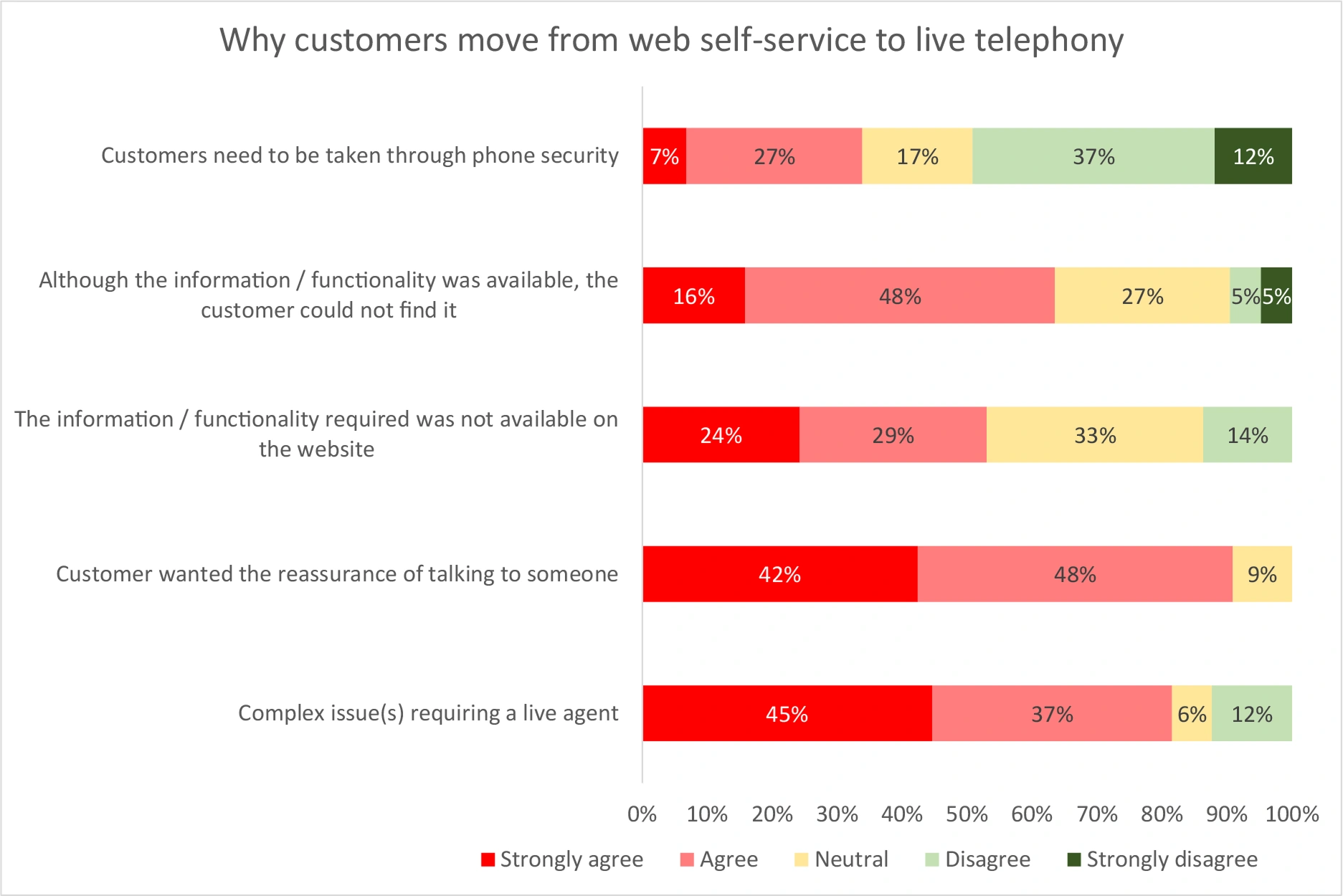
Looking more deeply at the reasons for this, one of the two most important reasons for moving from web self-service to live telephony was that the escalation involved a complex issue requiring a live agent to complete successfully.
90% of survey respondents also felt that customers wanted the reassurance that a live agent brings to a conversation. 53% stated that the functionality that the customer calling in required was not available online, but interestingly, 64% stated that they received calls about issues that could in theory be resolved online, but customers were unable or unwilling to do so.
So how can agentic AI help in these cases?
AI which can understand context, decide how to achieve the outcome and then act upon it across multiple systems and channels — which agentic AI is designed to do — can improve the sophistication of the self-service functionality. This will have a positive impact on the proportion of self-service sessions that fail due to being “complex issues requiring a live agent”: one of the key reasons for moving from web self-service to live telephony.
Agentic AI can also improve self-service outcomes in cases where the self-service functionality is available, but customers cannot find it or know how to use it effectively.
However, the customer requirement for wanting the reassurance of talking to someone will not be easily addressed. It will take a critical mass of effective agentic AI implementations for customers to change their widely-held belief that the best way of getting something done is by talking to someone.
Agentic AI for Digital Channels
Whereas only 15% of web chats had any automation involved in 2019, this grew to 39% in 2024, mainly as a result of initial handling by automated chatbots which may then hand off to live agents where appropriate, although fully automated AI-enabled web chat increased very significantly as well.
However, the past two years have seen little increase in the level of automation: it may well be that most of the chatbots being used are static rules-based applications and can only move onto the next level if more sophisticated AI applications are used.
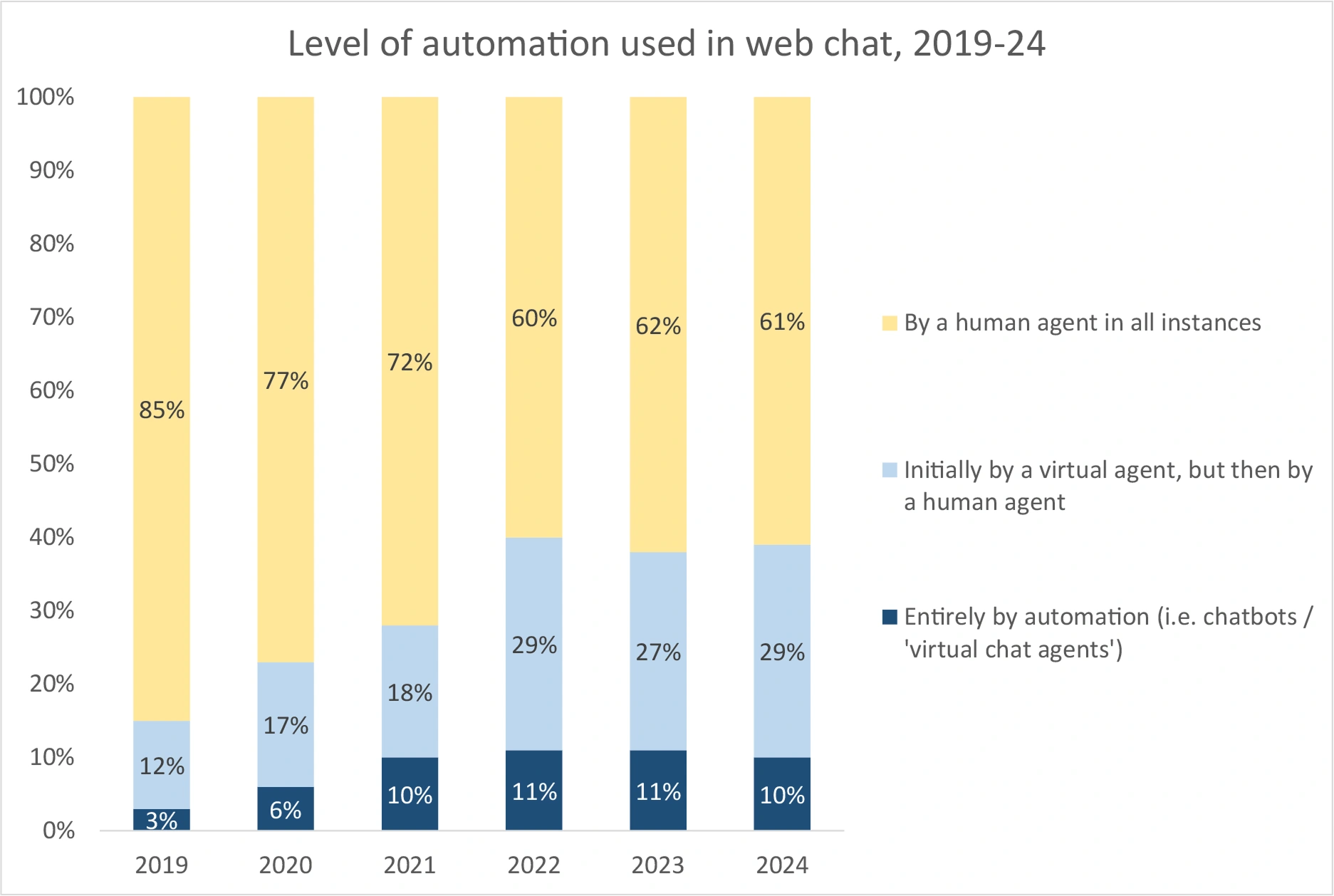
Currently, the level of sophistication in web chat automation is very low, with simple, rules-based functionality being the norm.
Agentic AI can be used in this case to act rather than just provide information. For example, using agentic AI for resolving a lost credit card could mean that the AI identifies the issue type from the customer’s original statement, verifies their identity, blocks the card, issues a new one and sends tracking details,, all without asking a human agent to carry out any of these steps.
While agentic AI will support the further uptake of automated web chat, a potentially even greater benefit could be seen by applying it to email.
Email accounts for around 19% of inbound interactions into US contact centers, compared to just under 8% for web chat.
Of even more importance, the chart below shows the extremely limited use of automated email handling.
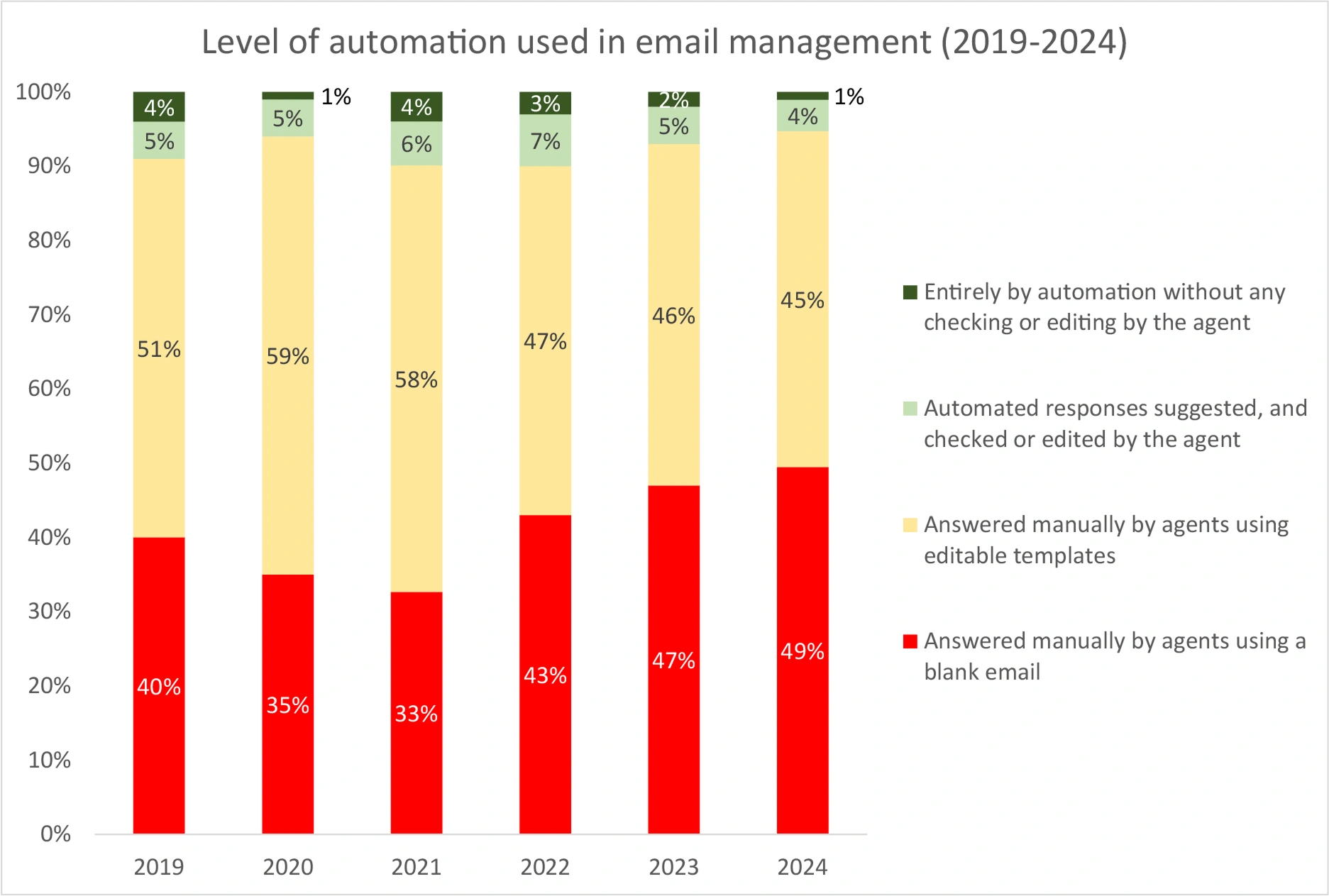
The most popular method of answering inbound emails is to use agents rather than automation.
45% of emails are answered by agents who start with templatised, editable responses and change them accordingly, thus not having to compose every email from scratch, but also being able to draw from a common pool of knowledge. Starting with a blank email and letting agents complete it themselves is not only likely to take longer, but also leads to an increased risk of poor grammar, spelling and punctuation, as well as a less consistent response.
Only 5% of emails have automated responses, (these statistics do not include simple automated acknowledgements), and of those, most are checked by agents before sending.
Clearly, having agentic AI handle even a fraction of these emails could make a very significant improvement to the speed at which emails are handled, freeing agents to answer calls and deal with edge cases and complex issues.
Agentic AI’s ability to work across multiple channels means that it understands the context and content of the entire interaction. It can also choose the channel most appropriate for resolution, for example, if a customer doesn’t complete a task (e.g. form submission), AI can follow up via email, SMS or telephone, schedule callbacks, send missing documents or complete pending steps.
AI-Enabled Analytics
The third main branch of AI in the contact center — along with agent assistance and self-service — is analytics.
While AI-enabling analytics doesn’t generate quite the same level of attention that the other two AI pillars do, it should be noted that an earlier chart showed that the no.1 reason for implementing AI in the contact center was to “better understand customers”: perhaps the central purpose of analytics.
Agentic AI can help organizations not only understand their customers, but also act appropriately: improving the customer experience rather than just drawing conclusions but not acting upon them.
- Compliance Monitoring: when listening to calls or scanning transcripts in real time, agentic AI can flag breaches such as missing disclaimers or privacy violations, initiating remediation workflows (e.g. notifying the compliance team)
- Sentiment and Risk Detection: after identifying signs of customer distress or frustration mid-interaction, the call can be escalated to a supervisor or retention specialist as needed. Actions can be taken immediately, such as a personalized retention offer without waiting for escalation or supervisor review
- Workflow Optimization: AI analyses bottlenecks or errors in resolution flows, suggesting or even implementing process improvements. For example, agentic AI notices that a specific issue often gets escalated and proposes a new automated resolution path
- Real-Time Decision-Making and Routing: agentic AI dynamically assigns cases based on workload, skill or urgency, re-routing interactions mid-flow if complexity increases. For example, AI initially attempts resolution, but upon identifying legal language, redirects the case to a specialist
- Fraud and Anomaly Detection: identifies suspicious behaviors or data inconsistencies, such as a sudden spike in high-value refunds, which prompts a halt, notifies supervisors and triggers an alert
- Appointment Scheduling & Management: agentic AI checks calendars, handles reschedules and sends confirmations and reminders. If there is a conflict with a customer’s existing appointment, AI can reschedule autonomously
- Billing and Payments: AI detects anomalies, manages payment plans, issues refunds or adjusts balances. For example, if a duplicate charge is noticed, AI can validate it against the billing system and process a refund without human escalation
- Proactive Notifications and Outreach: agentic AI monitors conditions such as network status or missed payments. It acts without prompting, sending proactive and personalized outreach to prevent calls about service issues, or offer upgrades.
Furthermore, AI-enabled analytics allows businesses to seek out key words and phrases, such as competitors' names or any instances of pricing, or to gather feedback after a marketing campaign goes out.
Some businesses are actively using AI analytics to uncover competitive intelligence as well. For example, one wholesaler uses analytics to identify when competitors' pricing information is mentioned on a call, and passes this back to the commercial team to revisit their own pricing structure.
Some businesses use agentic AI to carry out detailed and sophisticated analytics looking at a combination of variables in order to seek out correlations. For example, a business may discover that a combination of two issues mentioned by the customer on a call, as well as the mention of a competitor’s name is correlated with an extremely high churn rate.
In these cases, agentic AI real-time monitoring can trigger a customer offer to be made if these factors are identified within the call, or may use post-call analytics in order to trigger a post-call event such as an email, phone call or text message offering incentives to remain loyal to the company.
Regular references to competitors and their products can be captured, analyzed and automatically passed to the marketing or pricing teams to provide them with real-life, rapid and accurate information upon which to base decisions.
This categorization gives a starting point for analysis, meaning that businesses can listen to the right calls rather than selecting them randomly or employing large numbers of people to get insight from customers' calls.
Analysis of calls and digital interactions can reveal customer satisfaction with the service received, how customers feel about products or services, uncover product complaints and suggestions, and get insight into what drives customers away and what keeps them happy.
Customer experience and marketing departments are taking the opportunity to understand the customer perspective in relation to communications, website usage and product feedback, and having the ability to analyze all interactions in a single solution and find patterns and trends across all interactions has provided a new ‘voice of the customer’, moving away from relying on separate silos of data about the customer journey.
Analyzing human agent performance is another element that agentic AI can offer.
By its nature, judging and rewarding agents by evaluating only a tiny fraction of their interactions is a process prone to failure. Not only does the contact center run the risk of not fully understanding its employees’ skills, capabilities and learning requirements, but also the agent does not feel as though they are being assessed fairly.
AI-enabled WFO can significantly enhance fairness and personalization by continuously analyzing 100% of interactions across multiple channels, building a real-time, objective picture of each agent’s performance.
This removes bias from traditional evaluation methods and ensures recognition is based on measurable impact, such as quality scores, customer satisfaction, issue resolution rates and whatever else the organization deems to be desirable behaviors and outcomes.
Systems can also detect skill gaps and behavioral trends that show a need for targeted coaching or training, with agentic AI then being able to recommend and deliver individualized learning paths.
The impact on workforce engagement is powerful: fair and transparent recognition builds trust, while personalized coaching at scale makes employees feel valued and invested in. Agents are more likely to stay motivated when they see a clear link between their efforts, their development, and their rewards.
Implementing Agentic AI
Implementing agentic AI isn’t simply a software upgrade, but a strategic transformation that affects people, processes and platforms.
While every implementation is different, there will be similar factors to consider. This section outlines a step-by-step implementation path, keys to success and potential pitfalls.
It also suggests how to build a robust governance framework to ensure safety, transparency and accountability as autonomy increases.
Implementation Steps
1: Foundation Setup
Establish the infrastructure and access necessary for autonomous decision-making and task execution.
- Data Integration: connect customer data sources (CRM, IVR, knowledge bases, call logs)
- API & System Access: enable agentic AI to perform actions, not just observe or suggest (e.g. issue refunds or update tickets)
- Identity & Access Management: use role-based access controls to ensure AI respects security and privacy constraints
- Guardrails and Fail-Safes: implement privilege gating, execution logs and permission ceilings to restrict unsafe actions.
2: Define Agent Roles
Scope where agentic AI can be safely and effectively deployed.
- Target Repetitive, Rule-Driven Tasks: for example, password resets, billing disputes or appointment changes
- Create Agent Personas: each AI agent should have a defined domain, skillset, tone and decision authority (e.g., "Returns Agent", "Tech Support Bot")
- Specify Boundaries: what each agent can and cannot do (e.g. refund limit thresholds, or types of cases handled).
3: Train and Test
Build functional, safe agents using historical data and workflows.
- Prompt Engineering: define persona behavior and task logic in structured language prompts
- RAG/Knowledge Retrieval: equip agents to access policy and product data in real time. (RAG is ‘Retrieval-Augmented Generation’)
- Fine-Tuning: for high-volume tasks, train AI agents on historical transcripts or workflows
- Edge Case Simulation: test how agents respond to exceptions, failures and ambiguous inputs.
4: Deploy with Human-in-the-Loop Controls
Agentic AI should empower, not replace, human agents. The most effective implementations use human-AI hybrids that combine AI's consistency and speed with human judgment and empathy.
Train contact center agents to work alongside AI as collaborators, not competitors. Where possible, help them to understand how the AI 'thinks' and why it suggests certain actions, as well as allowing human agents to provide feedback and spot-check AI behavior in real time.
Start with shared decision-making and gradually increase autonomy.
- Set Confidence Thresholds: only allow AI to act autonomously when certainty is high
- Introduce Checkpoints: require human approval for critical steps (e.g. legal language or significant financial decisions)
- Allow Real-Time Human Intervention: Let human agents interrupt, override or redirect the AI mid-task.
Models of human-AI interaction include:
- Human-in-the-Loop (HITL): AI proposes actions, humans approve or edit them
- Human-on-the-Loop (HOTL): AI acts autonomously but notifies a human who can step in if needed
- Escalation-Based Models: AI handles routine; humans take over when complexity or sentiment thresholds are exceeded.
5: Monitor, Measure and Iterate
Continuously evaluate AI agent performance and trustworthiness.
- Operational KPIs: include those that are most important for your strategic goals, which may include first-contact resolution rate, average handle time, escalation rate and CSAT/NPS
- Oversight Metrics: also gather AI-specific data such as human override rate, error classification by task type and confidence vs. outcome correlation
- Feedback Mechanisms: create loops where supervisors and agents flag AI errors or improvement opportunities
- Version Control and Rollbacks: test new AI agent versions in sandbox environments before full release.
Governance Frameworks for Agentic AI
Deploying autonomous systems requires a formal governance structure which protects customers and ensures regulatory compliance.
AI solution providers are keen to emphasize their strong approaches to governance, without which there will be little confidence or desire from the market to implement agentic AI.
This section looks at some of the elements of agentic AI governance, but of course there will be others:
- Human Oversight: clearly define autonomy and confidence levels, after which human input and decision-making is needed. Use checkpoints, fallbacks and approval workflows.
- Transparency & Explainability: log the AI’s reasoning (e.g. why it issued a refund or escalated a ticket) and provide justifications to human overseers
- Access & Control: use rules-based access control (RBAC), which ensures that AI agents and systems only access the data and resources they need to perform their tasks, reducing the risk of unauthorized access and potential misuse of data. API scoping and execution limits should also be included. Limiting AI’s capabilities in this way should block high-risk actions such as sensitive data deletion without human approval.
- Accountability & Auditability: maintain detailed records of AI decisions: which AI agent / module triggered what, when and how, enabling reviews and rollback if required
- Bias & Fairness Monitoring: test regularly for unexpected impact or skewed recommendations and use human evaluations for edge cases or flagged interactions.
- Performance & Safety Thresholds: enforce confidence thresholds below which AI cannot act autonomously and trigger alerts for anomaly detection such as a large volume of high refunds.
- Data Privacy & Ethics: mask personally identifiable information (PII) during processing, ensuring AI aligns with GDPR, HIPAA, CCPA and any other applicable laws. Embed “do no harm” design principles, including identifying potential risks, making sure decision-making is transparent and paying particular attention to vulnerable customers.
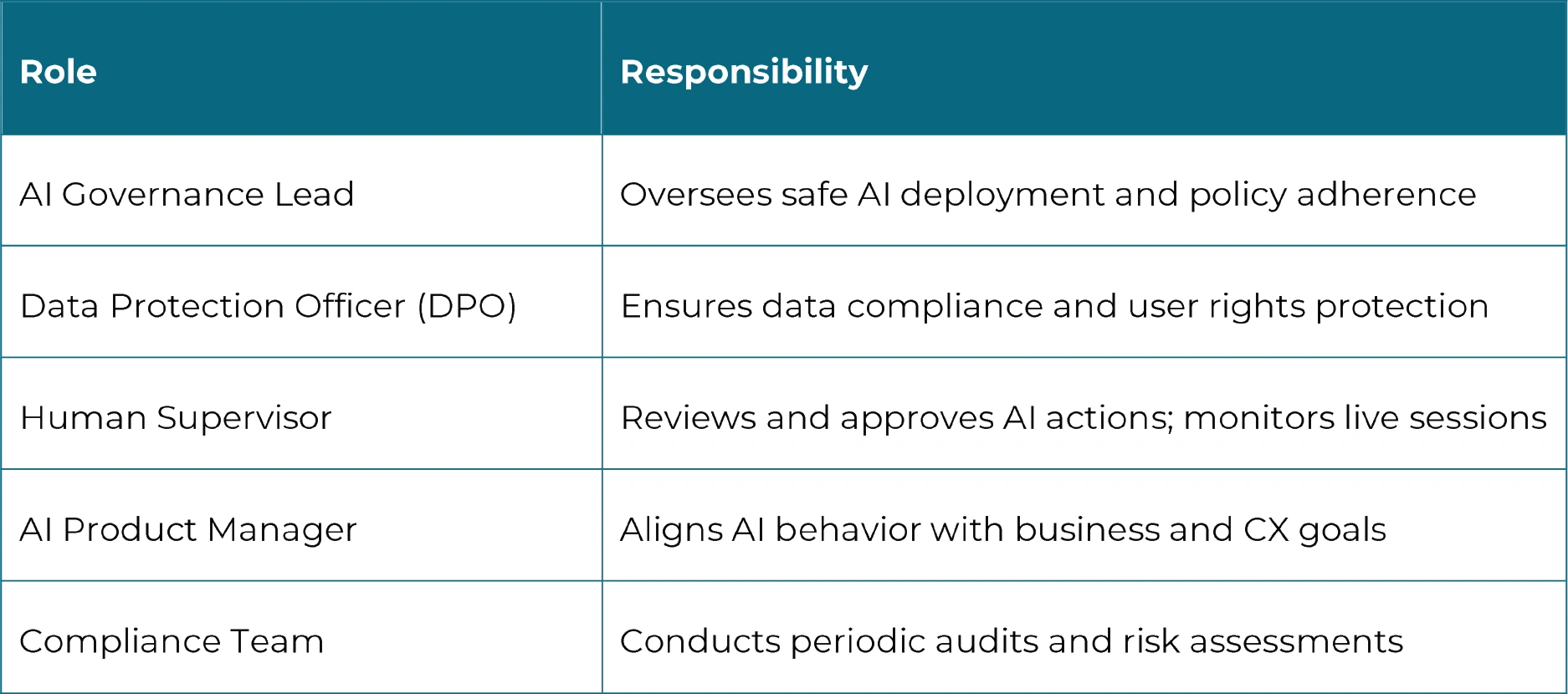
Organizations need to put agentic AI governance roles in place which focus on overseeing and guiding development and deployment. These roles ensure that these systems operate ethically, safely and in alignment with organizational goals and legal requirements.
Key areas of focus include establishing frameworks for responsible AI development, monitoring AI behavior and handling any issues that arise.
Keys to Success and Pitfalls to Avoid
Agentic AI is not a plug-and-play technology, but redefines how work is done and decisions are made. To prepare, CX leaders should consider the following:
-
Redesign the Operating Model: the predominant paradigm of current technology implementations is “human-led with AI assistance”, but the mindset and culture for agentic AI needs to move to “AI-led with human oversight”.
A key element of this is a deep understanding of which customer journeys and business processes can be owned by AI and which must remain human-first.
- Build Governance into the Core: autonomy without oversight creates the risk of data breaches, AI hallucinations and negative outcomes, including bad PR, fines and lost customers. The importance of building compliance, explainability and accountability into the AI lifecycle from day 1 cannot be overstated.
- Upskill and Empower Human Agents: train agents to become AI supervisors, coaches and exception handlers. They are the experts on handling high-empathy, high-complexity tasks: the type of interactions for which customers themselves state a preference for live telephony. This will mean building new career pathways for human agents and supervisors, who will work in a hybrid human-AI environment.
- Focus on Outcome-Driven Metrics: take the opportunity to rethink what success looks like: not just speed or deflection, but quality of resolution, customer trust, personalization accuracy and long-term loyalty impact. Using agentic AI does not mean that organizations simply do things more quickly.
- Start with High-Impact, Low-Risk Use Cases: areas such as password resets, account updates or appointment scheduling are potential initial use cases.
- Prioritize Transparency and Trust: give users and agents visibility into AI reasoning and make human interaction the default for edge cases.
- Align AI to Business Goals: ensure agentic AI supports measurable commercial outcomes such as reducing call duration and queue times, increasing FCR, or improving CSAT.
- Create a Feedback Culture: encourage agents to flag issues and suggest improvements, encouraging them to contribute to AI refinement.
- Build for Scale with Modularity: use composable agents or guides to scale from simple workflows to complex orchestration. Reuse proven capabilities where possible.
The most obvious pitfalls to avoid include:
- Unchecked Autonomy: giving AI full execution rights without thresholds or reviews can lead to systemic errors
- Siloed Systems and Poor Data: fragmented data pipelines reduce AI effectiveness and reliability. Fix underlying data hygiene and access issues before scaling
- Lack of Change Management Plans: human agents may resist AI unless involved in the process and shown how it helps them
- Overengineering the First Deployment: start small and avoid deploying a fully autonomous agent across complex tasks until the technology and your staff have proven competence.
Agentic AI implementation is a phased and iterative journey, not a single one-off deployment or integration.
Success comes from clear role definition, structured deployment, strong human oversight and governance by design.
When implemented properly, agentic AI becomes a force multiplier: reducing costs, improving service and elevating both agent and customer experiences.
The Future of Agentic AI in the Contact Center
Agentic AI is not just a technological milestone, but the start of a new operating model in customer experience.
As enterprises move from scripted automation to non-deterministic, reasoning-driven AI, agentic systems will become strategic differentiators.
The contact center industry is at the very beginning of a new way of working. Readers who have not yet moved on agentic AI should not be overly concerned: it is better to spend time planning and considering options, rather than worrying about falling behind and making rushed, expensive and damaging decisions.
As technology is changing so rapidly, it is very difficult to predict with real confidence how agentic AI in the contact center will be used in future years. Many of the following elements are available now, although not yet in mainstream use:
- Context-Rich, Memory-Based AI: agentic AI will maintain persistent memory across sessions, allowing true long-term personalization. AI agents will remember preferences, past resolutions and emotional tone, enabling proactive follow-up, recommending next-best actions and maintaining conversational continuity, even across multiple channels.
-
Reasoning-Enhanced Agents: moving beyond LLMs’ current limitations, agentic AI will incorporate symbolic reasoning and structured logic alongside neural inference. This will allow agents to handle complex edge cases (which currently have to be passed to human agents) and make explainable decisions which are critical in regulated industries such as finance, telecoms and healthcare.
However, it may well be that organizations decide to focus agentic AI on simpler cases, as the potential benefit from automating a relatively small number of edge cases may not be considered worth the risk.
- Multi-Agentic Systems: this refers to multiple autonomous agents, each with specialized skills such as billing, technical support or compliance, all collaborating on complex workflows. This modular approach is scalable, auditable and resilient, with each agent working as a member of a digital workforce with a clearly defined job.
- Proactive & Predictive CX: agentic AI means that organizations won’t need to wait for customers to reach out, as they will monitor risk, detect churn signals, trigger engagement and pre-empt service failures.
- True Omnichannel Agent Interfaces: AI agents will combine any channels, devices or visual tools it decides will get the best job done. For example, customers might speak to an AI agent, see a generated diagram or video tutorial and complete a payment transaction in one seamless session.
- AI Embedded Across Front, Middle and Back Office: agentic AI will bridge silos, coordinating across front-office (CX), middle-office (risk or compliance) and back-office (operations or distribution). This will enable end-to-end process automation, not just interaction support.
-
Vertical-specific Applications: solution providers will build dedicated AI agents trained on the requirements of specific business sectors. For example:
- Telecoms: diagnose network issues, upsell data packages, fraud detection
- Retail: handle returns, track orders, personalize product suggestions.
- Healthcare: reschedule appointments, collect consent, triage patients.
- Banking: block cards, flag fraud, provide financial advice based on past behavior.
The first steps for organizations considering agentic AI is to choose appropriate use cases and workflows which are high-value and low-risk. They should be repeatable and measurable, for example, appointment scheduling or return requests.
The word “guardrails” will be a key part of any conversation about agentic AI: use governance-first platforms that support explainability, feedback loops and safe execution.
In the same way that a human agent is given a job description, do the same for the AI agent: define the role, tone, permissions and KPIs of each.
Invest in the AI infrastructure, including prioritizing data architecture, API readiness and observability tools.
Emerging capabilities for agentic AI are being developed all of the time, but current hot topics include:
- retrieval-augmented generation (RAG), where AI agents pull data from up-to-date sources in real time to reduce hallucinations and ensure accuracy
- LLMs trained to decide when and how to use tools during task execution
- Adding emotional capabilities to agentic AI: systems will combine sentiment recognition with agentic decision-making to handle churn pre-emptively or deal with complaints or escalations.
The future of customer experience is not just faster or cheaper, but also more proactive and autonomous.
Agentic AI will enable contact centers to evolve into intelligent orchestration hubs, blending machine speed with human empathy to provide the best of both worlds.
The winners will be those who design for autonomy and governance together: who embrace AI not just as a tool, but as a team member.
About ContactBabel
ContactBabel is the contact center industry expert. If you have a question about how the industry works, or where it’s heading, the chances are we have the answer.
We help contact centers compare themselves to their closest competitors so they can understand what they are doing well, what needs to improve and how they can do this.
The coverage provided by our massive and ongoing primary research projects is matched by our experience analyzing the contact center industry. We understand how technology, people and process best fit together and how they will work collectively in the future.
e: info@contactbabel.com | w: www.contactbabel.com | t: +44 (0)1434 682244
Free research reports available from www.contactbabel.com (US and UK versions):
-
The Inner Circle Guide to:
- Agent Engagement & Empowerment
- Agentic AI
- AI-Enabled Agent Assistance
- Chatbots & Voicebots
- Cloud-based Contact Center Solutions
- Customer Engagement & Personalization
- Customer Interaction Analytics
- First-Contact Resolution
- Fraud Reduction & PCI Compliance
- Omnichannel Workforce Optimization
- Remote & Hybrid Working Contact Center Solutions
- Self-Service
- Voice of the Customer
- The UK Contact Centre Decision-Makers’ Guide
- The UK Customer Experience Decision-Makers’ Guide
- Exceeding UK Customer Expectations
- UK Contact Centre Verticals: Communications; Finance; Insurance; Outsourcing; Retail & Distribution; Travel; Utilities
- AI in UK Contact Centre Verticals: Finance; Insurance; Retail & Distribution; Utilities
- The US Contact Center Decision-Makers’ Guide
- The US Customer Experience Decision-Makers’ Guide
- Exceeding US Customer Expectations
- US Contact Center Verticals: Finance; Insurance; Outsourcing; Public Sector; Retail & Distribution
- AI in US Contact Center Verticals: Finance; Insurance; Retail & Distribution
-
The AI Series: how can AI can help contact centers’ operational and commercial issues?
Research reports: First-Contact Resolution; Sales Growth; Workforce Engagement; Business Insights: Customer Insights; Agent Productivity; Digital Customer Contact; Contact Centre Cost Reduction; Customer Satisfaction.
¿Te ha resultado útil y quieres obtener más insights?
Leer más
Contenido relacionado
Artículo de blog
Cómo evitar las alucinaciones de la IA
Caso de estudioUnifique sus canales digitales para ofrecer una CX moderna
Caso de estudio40% más contactos, 4x más cobranza: la transformación outbound de Bankaya
Resumen de soluciónCómo una plataforma unificada de CCaaS y CRM transforma la CX
Serie de videos¿Quiere llevar su CX al siguiente nivel? La IA puede ayudar
BlogImpulse el futuro de la experiencia del cliente desde TI
BlogLidere con propósito en la era de la IA
Webinar on-demandLibere el poder de WhatsApp en su estrategia de CX
Caso de estudioCómo el banco más grande de Chile transformó su centro de contacto
InfografíaResuelve el dilema de la confianza en la IA agéntica
GuíaPor qué el futuro de la CX depende de la orquestación inteligente
GuíaToma la decisión correcta al invertir en CX
WebinarCinco tendencias que todo directivo de CX debe seguir en 2026
WebinarIA que genera valor en cada punto de contacto
BlogElimina los silos para unificar la CX
DemoIA agéntica que navega la “zona gris” de la lógica humana
InformeSaca el máximo potencial de la IA agéntica con las nuevas herramientas de Genesys
BlogCrea experiencias más humanas impulsadas por IA
Descripción general del productoCrea conversaciones inteligentes con IA
BlogCómo los líderes de CX pueden diferenciarse con IA
Caso de estudioAeromexico transforma la experiencia del cliente con Genesys Cloud
BlogCómo CCaaS impulsa la fidelización y el crecimiento